playing deliberately(?)
it is not that the thing i am playing is total crap, but the quality is not constant, if you know what i mean.
There are no comments, leave a comment.
the more you play/practice, the smaller your margin of inconsistency (the better your chances of playing well)...sometimes you have it sometimes you don't...but your "dont's" get a lot better as you mature as a player...the best baseball players in the world only get a hit %30 of the time...but when they do, it's a beautiful thing :)
by reading your post i understand that your subconscious outcrops when you are playing. that's a priviledge!
you may know guys who play an instrument in a hight level, without studies of music... they do it thanks to subconscious.
your subconscious is a powerful computer... load correct info, practising "deliberately" as you mention chords, scales, arpegios, progressions, and all kind of musical elements, and you will be a great musician.
one of my oldest threads in my room "albetan's" is about subconscious in music. please read it...
now, you wouldn't want to do that on stage for a whole tune, but for practice what it does is burn into your mind the minor third sounds and sizes, physically, that your hand and fingers have to reach.
let's say you do this for a month, and every day you switch the interval to something else.
after that, and during it, when you are stage, you'll notice that you are more in "the zone" and playing more what you hear, and even your subconscious tendencies will appear to be more in the zone.
proper practice technique is often the only thing that seperates the great players from everyone else.
Scot is available for skype jazz piano lessons (and google hangouts, phone call, etc...)
Use the contact link at the top of the page.

by Scot Ranney on 07/09/2004, 10:19
albetan: have read your thread before, but didn't realize this is what your meaning:)
smg: i've begun to read developing, i will finish it some other time. the efficiency of studying is not that great anymore. i am sure it will help me!!
thanks for your posts everybody!!
gv
for example, perfect 4ths with different physical sizes: c-f, f#-b, c#-f#, etc.
Scot is available for skype jazz piano lessons (and google hangouts, phone call, etc...)
Use the contact link at the top of the page.
by Scot Ranney on 07/12/2004, 12:56
okay, okay... what i was referring to was the sound of a particular interval over progressions for soloing purposes. as far as feel (really real feel in the fingers) goes i am unfortunaltely ignorant on that subject as i am currently stuck with a cheap board with no feel whatsoever.
anywho, i believe it would be important to practice in all keys whether you're using a lamer board like mine or not just to get the pattern down, no? as for the tactile thing, well... i'll leave that to you experts for now ;)
gv
thank much,
gv
basically, if you hold an imaginary bottle of your favorite beverage or goo, and pour it onto the keys, you would end up with a pretty good hand position...play on the tips of your fingers instead of the finger print pads....use the weight of your arm to play evenly...swing your elbows outward to help using your 5th finger (pinky) and inwards to help your thumb...voila - you be jammin:)
i just explain it a different way:
"ergonomic" is the key word here.
if you hold your hand out in front of you with your hand level to the forearm, your fingers naturally assume the correct position.
the last part of your fingers is where the power comes from. fingers 2, 3 & 4 should be basically perpendicular to the keys for maximum control.
yet not so perpendicular as to feel in any way uncomfortable.
the thumb must always be able to reach deep into any white key. the pinky naturally falls into line.
the part of the finger closest to the hand is basically level with the hand, wrist and forearm (which are basically level with each other).
playing flat fingered makes you sound sloppy and floppy.
7
ps: keep your nails short

Scot is available for skype jazz piano lessons (and google hangouts, phone call, etc...)
Use the contact link at the top of the page.
by Scot Ranney on 07/14/2004, 12:05
Are you in the Pacific Northwest looking for a jazz jam? Check out our weekly Bellingham Jazz Jam!
Jazz Piano Notebook Series

Volume 1 of this educational jazz piano book contains 15 jazz piano exercises, tricks, and other interesting jazz piano techniques, voicings, grooves, and ideas Scot Ranney has picked up over decades of playing on stage.
Being a pro jazz pianist requires good ears, experience, and a bag of tricks that create the kinds of sounds people expect to hear from a jazz pianist. The entries in this book will give you some of those tricks.

"Latinesque"
Volume 2 has 14 jazz piano exercises and tricks of the trade, and quite a bit of it is Calypso jazz piano related material, including some Monty Alexander and Michel Camilo style grooves. Jazz piano education is through the ears, and books like this help connect what you're hearing to what you want to play.
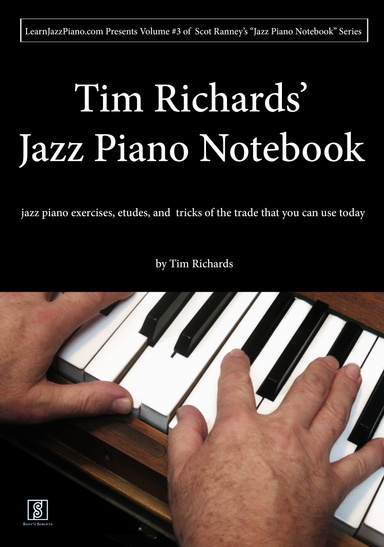
Volume 3 contains 12 jazz piano exercises and explorations by the acclaimed jazz piano educator, pianist, author, and recording artist Tim Richards.
Tim wrote the well known "Exploring Jazz Piano" and "Improvising Blues Piano" books and has several others to his name.
Tim has a new book out Beginning Jazz Piano (Pts 1 and 2)
Many of Tim's books now come with free access to interactive sheet music ONLINE, which permits slowing down of the backing and performance tracks, as well as the option to loop passages for practice purposes.
Tim now also has online VIDEO courses for his books, including Beginning Jazz Piano, Improvising Blues Piano and Exploring Jazz Piano Vol 1:
buy pdf version Tim Richards' Jazz Piano Notebook Volume 3 -
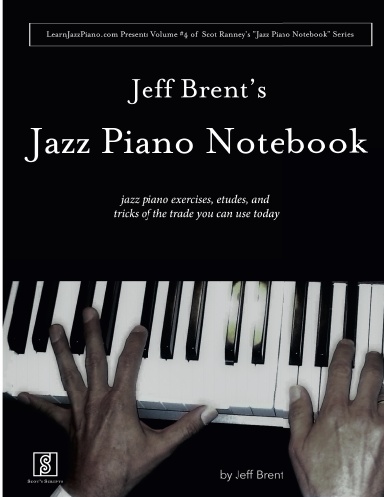
Volume 4 is by Jeff Brent, a jazz pianist, composer, teacher, and author of "Modalogy" and other acclaimed jazz theory and education books. In this book Jeff shares detailed analysis of transcriptions of live performances. He covers everything from the shape of the songs to the tricks and licks he uses in improvised lines to the ideas behind his lush chord voicings.
Most Recent Discussions
Articles
Piano for Adoption Scam
Aprender Jazz en Piano
BEWARE: FREE BABY GRAND PIANO SCAM
Oh Tannenbaum for Jazz Piano
Volume 5 of the "Jazz Piano Notebook Series" is Available!
LearnJazzPiano.com File Downloads News
more...
Top Sheetmusic Picks
Jazzy Christmas Arrangements
Cocktail Piano
Best Songs Ever, 6th Edition
Christmas Medley
Moana Songbook
Late Night Jazz Piano
Jazz piano education is cool.

Rock on. Follow your passion.
Sign In
LearnJazzPiano.com Copyright © 1995-2026 by Scot Ranney • website software and design by scot's scripts
LearnJazzPiano.com is For Sale - Serious Inquiries Only