Theory Professor's Negative Review of Mark Levine's Book
of mark levine, the jazz theory book.
https://www.societymusictheory.org/mto/issues/mto.00.6.1/mto.00.6.1.rawlins.rev
dr. robert rawlins
chair, department of music, music theory
"robert rawlins is associate professor and coordinator of music theory and chair of the department of music at rowan university. in addition to a ph.d. in musicology, he holds master’s degrees in music history & theory, humanities, and public relations. he is author of a simple and direct guide to jazz improvisation (hal leonard, 1995), classic jazz solos for practice and study (in press), intermediate serial duets for two flutes (southern music, 1990), and has published more than 50 articles on various aspects of music theory and performance. dr. rawlins has performed extensively on flute, saxophone and clarinet in both jazz and classical venues."
There are 25 comments, leave a comment.
the thing i like about levine's books is they are very practical, very comprehensive, and have a lot of detail. maybe they aren't super well organized, but after a cover-to-cover read you can go back and fish out what you need. without knowing anything about it, i bought one of his books from amazon.com along with three or four by other authors, thinking "ok i'm finally going to learn some practical jazz theory". the other books were way too simple to be practical, for example jerry coker's "improvising jazz". they've been read once or twice and stuck on a shelf. summary: "ii-v-i, practice some scales, improvise some motifs, ok now you're playing jazz!" ok, but how do i make myself sound more like herbie hancock?
the book review was interesting. definitely sounds like a professor who wishes the book had been written for academic purposes instead of practical jazz purposes.
i think that levine did a great job with the book in following the reasons why he wrote it. to use it in a classroom at a university or something would probably require a third party to create a coherent classroom study book that can be used in conjunction with the jazz theory book as reference material.
whoever made this supplemental study book would probably make some money off it.
Scot is available for skype jazz piano lessons (and google hangouts, phone call, etc...)
Use the contact link at the top of the page.

by Scot Ranney on 11/19/2004, 05:34
as to the specific criticisms, this one made me smile. in an analysis of 'just friends' levine is criticised in this way....
"this inexplicable analysis requires three keys
to explain what is obviously a commonplace chord sequence in the
key of g major. the analysis that most readily presents itself is
a iv followed by iv7 (borrowed from the parallel minor), the
insertion of the related v7 of the cm7 as a chord substitution
(nonstructural), leading to i"
i don't know any real jazz musicians that would think of just friends as being in one key - good luck playing g major over the whole thing!
your comments on the analysis of "just friends" caught my eye.
i don't have the levine book, so i'm not really sure how he analyzes "just friends". the reviewer seemed to disagree with levine's analysis and you disagree with the reviewer's analysis.
my analysis of "just friends" (posted in the "monthly standards" section here in hard to read .txt fromat - and currently either unavailable or corrupt) shows the entire first section as being as series of chromatically descending minor triads over a g pedal tone.
as a consequence the entire first part of the tune is in "g". but not necessarily always "g major", see?
here is a direct link to my analysis of "just friends" and i promise to get around to making a pdf file of the analysis to post in the "jf" room.
https://www.jeffreebrent.com/lessons/jfanalysis.html
it would be interesting to me (and maybe others here) to contrast a complete version of levine's analysis with mine (or anybody's analysis for that matter)

first, i agree with him about the susb9 being in the book so early........i thought the exact same thing! how does this come before the blues?!
he is correct about ain't misbehavin' and that the original chord was an ab, however.......if one kept c in the bass and just moved the g up to ab.....jazz musicians would not think of it as an inversion. they would think of it as c-b6, just like levine writes in the book. he is crossing out of jazzland and into traditional land, here(the reviewer).
he says that the early cats wouldn't have used locrian over -7(b5)......well, probably not.....why? because they generally didn't even use -7(b5) chords! well, they did.....but, they were notated as an inversion of a minor6 chord(a-7(b5) would be notated as c-6/a). so, this melodic minor chord, is actually where the harmony derived from.....which is that locrian#2 scale he refers to, and he is correct in saying that they probably didn't even think about locrian at all. but........he just didn't go far enough with that arguement to be really convincing to me. he should've said that it comes from melodic minor..and, mark......well, he should have, too :o) if any of you haven't tried thinking melodic minor over -7(b5) chords..........try it.........it makes a world of a difference. any line that you use for c-6, can most likely be used for a-7(b5).
sus chords............he is incorrect in saying that the 3rd should be left out of a sus chord. if you play the third above the 4th, it can sound great. but, alas, he only talked about the instance of it that would create a minor9th. this voicing g, f, c, f, b......can sound killin.
he is correct about the analysis of just friends. i don't know what levine was thinking when he made that analysis. it starts on the iv chord.
a lot of the review comments seem to come from guys whith a solid wide ranging theory base base. for the at least partially clueless i think levines oversimplifications that are commented on actually help (guess that shows his intent of practical application indeed works). levines description of mode-chord/scale equivalence opened the door to me using chord forms (i'm a guitar player) embelished with passing tones to guide solos as opposed to just scales, ...it's a visualization thing for me. that combined with some study of charlie christian seriously helped out my playing. as i learn more about voice leading and substitutions i get a wider pool of tonal options but the way of looking at chord/scale relationships levine opened up for me really helps me tie things together.
i'll tell you an awesome guitarist with awesome practical regiem for guitar is jimmy bruno's no non-sense jazz guitar course. its from hotlicks i think. you ought to try it.
jv'
p.s. sorry for the hijack guys, i just couldn't resisit. :)
i'm not sure why the theory professor felt the need to review and critique a non-academic book like mark levine's. up until recently, jazz was not an academic subject at all.
-j
academians often don't get it when it comes to the real world, by virtue of their chosen paths in life, they often live inside their head. compare this to mark levine who is not only active in books and passing jazz info along to people who strive to learn more, but also a great player who gigs and records all the time.
there's no hesitation as far as who i'd want to sit down with for an hour and pick his brain.
Scot is available for skype jazz piano lessons (and google hangouts, phone call, etc...)
Use the contact link at the top of the page.
by Scot Ranney on 02/19/2006, 15:39
-j
-j
there's another one he does in the west, too.
i remember being in some of his sessions at the stanford workshop... he was actually playing gigs in s.f. a few of the nights during the workshop.
at any rate, he seemed much more open to discussion and different ideas than this theory professor would be.
the bottom line here is that there is always room for improvement, and while levine's books are constantly showered with praise (and probably rightly so), it doesn't mean that the are the "final gospel" and if someone can do a better job - more power to them.
as the author of the article points out, this is a scheme that yields fairly quick results when beginning improvisers look for a way to tackle their first attempts at improvising. having a chart of scales (like the page in all aebersold play-a-long volumes) showing all the scale options that might be played over any chord type produces almost instant - though often very mediocre - results. i still take this approach with beginning improvisers. however, it is good to see the tide changing gradually, with more and more attention being paid to the hierarchy of notes in these scales, and also how the notes in the scale resolve.
elsewhere, on another thread, mention is made of hal galper and ‘forward motion’. bert ligon's books are also excellent for this ('connecting chords with linear harmony' and 'jazz theory resources: tonal, harmonic, melodic and rhythmic organization of jazz.' volume i and ii.). like 'the jazz theory book' and 'the jazz piano book', these books are full of actual examples of real players’ musical phrases but the analysis emphasizes different things. but, instead of just the notes of an appropriate scale being the basis of the analysis, the ligon book focuses more on the way the notes in the example resolve or where they move as the harmony changes. the notes of the scale(s) are there (just as levine or aerbersold would point out), but little or no consideration is given to their order, the relative importance of each note in that context, which notes from the scale have been omitted and where they fall in relation to the underlying rhythm and harmony.
certainly, the’ jazz piano book’ is an excellent book for jazz piano students tackling jazz – lots of practical advice for all of us playing piano in the real world. it does seem to me though, that to follow his best seller with a ‘jazz theory book’ does invite the sort of criticism he has received from robert rawlins.
Scot is available for skype jazz piano lessons (and google hangouts, phone call, etc...)
Use the contact link at the top of the page.
by Scot Ranney on 02/20/2006, 12:19
-j
i bought a copy because nor is my friend and we're always talking here about supporting hard-working musicians so that they can benefit from their hard labor and yada yada yada ...
otherwise i would never have bought a book that i already know virtually everything inside already.
nor asked me to let him know what i think about and i will, but that's from me to nor.
as it stands, i think it's a very well thought out and well paced book. there is a logical order to it, and it seems to cover pretty much everything.
it's set up so that it can be used in a classroom setting with exercises and lots of examples to go along with it.
so far my only critique is that i would like to have a cd along with it so that i could listen to the examples as well as read through them (the book assumes that you can read music).
jv'
the levine booked helped me better use those scale forms by showing the harmonic relationship between the chords and scales. i knew minimal harmony when i got the book. those relationships allowed me to figure out how to build chords/arpeggios on the run and visualize them as part of the scale instead of memorizing a million patterns. that skill in turn lead to visualizing how parts of one chord made up parts of another which led to a better understanding of voice leading and use of passing tones to tie everything together.
i'm really at the tip of the iceberg level but my solos have improved a lot and have become more stylistically adaptable as a result of getting the basics down. i don't read music enough to play from music so the pattern and scale tone number thing is key, levine helped a lot. i'm trying to self learn piano with a similiar approach coupled to maybe actually learning to read. at least with a guitar once you get the chords and scales worked out in one key you just move them around for all 12.
while the keyboard seems initially easier to grasp given that everything you can do with in one octave within a key just repeats, you actually have to know all the scales et. kind of daunting with lees success at cheating based on a few patterns, as can be the case with guitar. dorian and a few basic barre chords took me through about 15 yrs of rock and new wave before i even found out the scale was called dorian and what it represented. glad them days are over
Are you in the Pacific Northwest looking for a jazz jam? Check out our weekly Bellingham Jazz Jam!
Jazz Piano Notebook Series

Volume 1 of this educational jazz piano book contains 15 jazz piano exercises, tricks, and other interesting jazz piano techniques, voicings, grooves, and ideas Scot Ranney has picked up over decades of playing on stage.
Being a pro jazz pianist requires good ears, experience, and a bag of tricks that create the kinds of sounds people expect to hear from a jazz pianist. The entries in this book will give you some of those tricks.

"Latinesque"
Volume 2 has 14 jazz piano exercises and tricks of the trade, and quite a bit of it is Calypso jazz piano related material, including some Monty Alexander and Michel Camilo style grooves. Jazz piano education is through the ears, and books like this help connect what you're hearing to what you want to play.
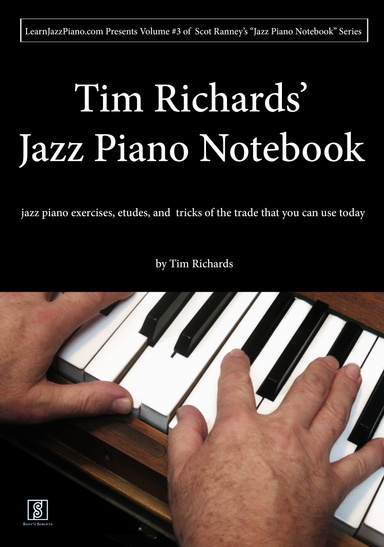
Volume 3 contains 12 jazz piano exercises and explorations by the acclaimed jazz piano educator, pianist, author, and recording artist Tim Richards.
Tim wrote the well known "Exploring Jazz Piano" and "Improvising Blues Piano" books and has several others to his name.
Tim has a new book out Beginning Jazz Piano (Pts 1 and 2)
Many of Tim's books now come with free access to interactive sheet music ONLINE, which permits slowing down of the backing and performance tracks, as well as the option to loop passages for practice purposes.
Tim now also has online VIDEO courses for his books, including Beginning Jazz Piano, Improvising Blues Piano and Exploring Jazz Piano Vol 1:
buy pdf version Tim Richards' Jazz Piano Notebook Volume 3 -
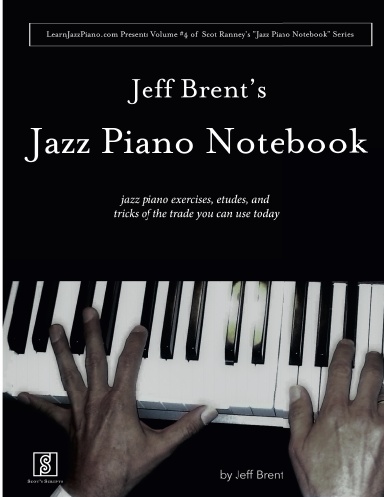
Volume 4 is by Jeff Brent, a jazz pianist, composer, teacher, and author of "Modalogy" and other acclaimed jazz theory and education books. In this book Jeff shares detailed analysis of transcriptions of live performances. He covers everything from the shape of the songs to the tricks and licks he uses in improvised lines to the ideas behind his lush chord voicings.
Most Recent Discussions
Articles
Piano for Adoption Scam
Aprender Jazz en Piano
BEWARE: FREE BABY GRAND PIANO SCAM
Oh Tannenbaum for Jazz Piano
Volume 5 of the "Jazz Piano Notebook Series" is Available!
LearnJazzPiano.com File Downloads News
more...
Top Sheetmusic Picks
Jazzy Christmas Arrangements
Cocktail Piano
Best Songs Ever, 6th Edition
Christmas Medley
Moana Songbook
Late Night Jazz Piano
Jazz piano education is cool.

Rock on. Follow your passion.
Sign In
LearnJazzPiano.com Copyright © 1995-2026 by Scot Ranney • website software and design by scot's scripts
LearnJazzPiano.com is For Sale - Serious Inquiries Only