God rest you merry, gentlemen
the words of this song have always seemed to me to be at odds with the strangely brooding, minor key feel of the melody - a bit like "my favorite things", which also sings of cheerful matters like kittens and mittens to a frankly sinister refrain. on the subject of the words, by the way, note that the gentlemen of the title are not merry - they are being greeted with the old english blessing "god rest you merry", which is why the comma should come between "merry" and "gentlemen", not "you" and "merry". but i digress...
this tune is nice to play around with because it has no accidentals (strictly speaking it's in the aeolian mode) and is practically all quarter notes. it can be played as swing, funk, latin or even waltz time. my arrangement sticks to the straight on-the-beat representation of notes but in practice it works pretty well if you morph it into any kind of jazz style. the chord progression is as vanilla as i can make it. in a couple of bars (8 and 9) i've put the symbols in brackets where they don't strictly correspond to the dots, because i introduced a little harmonic flourish, just for fun.
to explain a bit of the thinking behind the harmonisation: it's not too difficult to fit pretty standard progressions to gentlemen, such as the "hit the road, jack" groove, or the chromatic figure from the start of "in a sentimental mood", not to mention old standbys like ii v i. but i thought it would be interesting to begin with a progression that wouldn't normally be thought of as in the jazz idiom. i first heard this sequence (am c dm f with a moving bassline) in a piece by the irish piper davy spillane (which i've performed jazz-style now and then) and it has a very nice sense of upward movement that gives each chorus momentum from the start. for improvisation purposes this progression is repeated over the next 4 bars, ending in a modulation into bm7b5. i've represented the link between the f and b chords as a basic c7, but in fact there's a lot of scope for crafty voicings, substitutions and interpolations at this point and i tend to approach it as a major landmark in each improvised chorus.
from here on there's an extended passage of harmonies descending stepwise from the bm7b5, ending eventually back at am. instead of moving through the chromatic equivalent of the cycle of fifths, i prefer when possible to follow m7b5s with dims - e.g. bm7b5 bbdim (bar 10), f#m7b5 fdim (bar 12), em7b5 ebdim (bar 13). this is also a simple way of achieving smooth voice-leading. when i reached the am in bar, i permitted myself a couple of bars of ii v to modulate to the f in bar 15, employing a sequence often used towards the end of "my funny valentine". the last few bars include a couple of variations on the minor ii v i theme.
finally some words about the voicings used in the notation. the arrangement is pretty much as i played it straight into the sequencer. i tidied up some of the timings with a touch of quantise (not too much) and i cleaned up a few notes here and there, but it's basically how i would normally play it as a slowish piano solo. i like the ambiguous sound of minor chords that omit the third and include 7ths, 9ths and 11ths, clustered where possible. i've used this kind of voicing in bars 2 and 6. the last note in bar 2 is harmonised as a spaced-out gmaj7, which gives a brief modal flavour. another favourite trick is to use inversions of relatively unadorned chords including simple triads. i discovered the joys of inversions relatively late in the development of my understanding of harmony and maybe i use them more than i should, but i like the change of texture they introduce when integrated with the more conventional jazz voicings. i've employed one such in bar 6 on the g/b chord. the em chords in bars 3 and 9 can also be played as c/e, for variety's sake. overall i've aimed for a pretty spare, open feel for the melody, but i think the progression offers plenty of scope for development into much denser, two-handed textures as well as inspiring interesting improvised lines. i hope my account of the thinking behind the arrangement makes sense and that, pianistically speaking, god will rest you merry.
sid
There are no comments, leave a comment.
Are you in the Pacific Northwest looking for a jazz jam? Check out our weekly Bellingham Jazz Jam!
Jazz Piano Notebook Series

Volume 1 of this educational jazz piano book contains 15 jazz piano exercises, tricks, and other interesting jazz piano techniques, voicings, grooves, and ideas Scot Ranney has picked up over decades of playing on stage.
Being a pro jazz pianist requires good ears, experience, and a bag of tricks that create the kinds of sounds people expect to hear from a jazz pianist. The entries in this book will give you some of those tricks.

"Latinesque"
Volume 2 has 14 jazz piano exercises and tricks of the trade, and quite a bit of it is Calypso jazz piano related material, including some Monty Alexander and Michel Camilo style grooves. Jazz piano education is through the ears, and books like this help connect what you're hearing to what you want to play.
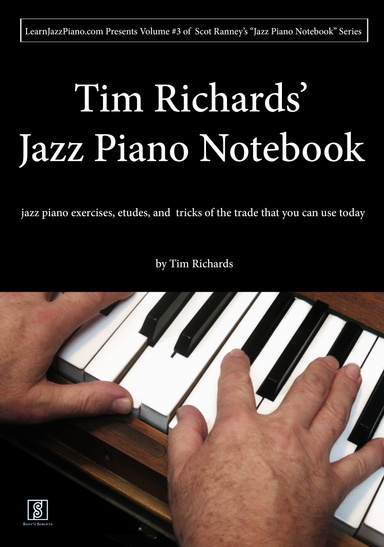
Volume 3 contains 12 jazz piano exercises and explorations by the acclaimed jazz piano educator, pianist, author, and recording artist Tim Richards.
Tim wrote the well known "Exploring Jazz Piano" and "Improvising Blues Piano" books and has several others to his name.
Tim has a new book out Beginning Jazz Piano (Pts 1 and 2)
Many of Tim's books now come with free access to interactive sheet music ONLINE, which permits slowing down of the backing and performance tracks, as well as the option to loop passages for practice purposes.
Tim now also has online VIDEO courses for his books, including Beginning Jazz Piano, Improvising Blues Piano and Exploring Jazz Piano Vol 1:
buy pdf version Tim Richards' Jazz Piano Notebook Volume 3 -
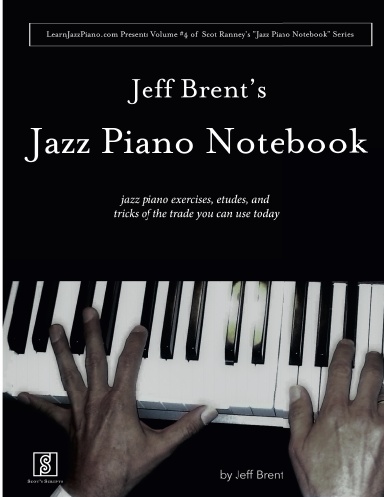
Volume 4 is by Jeff Brent, a jazz pianist, composer, teacher, and author of "Modalogy" and other acclaimed jazz theory and education books. In this book Jeff shares detailed analysis of transcriptions of live performances. He covers everything from the shape of the songs to the tricks and licks he uses in improvised lines to the ideas behind his lush chord voicings.
Most Recent Discussions
Articles
Piano for Adoption Scam
Aprender Jazz en Piano
BEWARE: FREE BABY GRAND PIANO SCAM
Oh Tannenbaum for Jazz Piano
Volume 5 of the "Jazz Piano Notebook Series" is Available!
LearnJazzPiano.com File Downloads News
more...
Top Sheetmusic Picks
Jazzy Christmas Arrangements
Cocktail Piano
Best Songs Ever, 6th Edition
Christmas Medley
Moana Songbook
Late Night Jazz Piano
Jazz piano education is cool.

Rock on. Follow your passion.
Sign In
LearnJazzPiano.com Copyright © 1995-2026 by Scot Ranney • website software and design by scot's scripts
LearnJazzPiano.com is For Sale - Serious Inquiries Only