Which major scale are we in?
can you tell me of any errors i've made? i might not have got all the us chord symbols for example.
the site is www.jazzsmugglers.com if anyone out there wants to link their site with ours could you tell me and i'll put their site on ours, so long as it is on topic as they say.
also if anyone wants to copy this material for their own pupils then please do so. you don't need permission from me. (it would be nice if you gave our site a mention, but you don't have to. anyway, if you do, then thanks.)
i'd be grateful for corrections - please use tlc. i'm just an amateur trying hard.
which major scale are we in?
introduction
i thought this was going to be easy. i was wrong.
one of the problems for newcomers to jazz is to determine where their solos should be positioned. keys change throughout a song. scales are often ambiguous, two or three different scales can be used over different sequences of chords. notes used outside the scale are very common indeed. but you’ve got to start somewhere, and the major scale is the most common place. not the only place – you may have minor scale sequences too, but let’s keep that for another time.
one tip. the key signature at the start of a song may not be a reliable guide for the overall feel of the piece. have a look at the last chord of the song. that’s the basic key in which it has been set. it will nearly always resolve there.
in this, we’ve put in the scale notes, the chord symbols, and the modes and their names. knowing modes and names is useful but not essential. knowing scales and common chord symbols is essential.
sometimes a song can be played using all one scale – autumn leaves. sometimes a song just uses a different scale in part of the bridge – blue moon. sometimes a song uses many changes – all the things you are, to those in the know, “all the chords you’ve got.” sometimes the changes just move together easily and there is only one note different between one scale and the next. blues sequences are like this, and this is one reason why the blues is so popular for musicians of any standard.
you can have too much theory, and it can stop you playing. jazz theory is often invented after you have played it. “you played a tritone fifth substitute there” “oh, did i really, i just thought it sounded nice” chet baker once sat in with my pal terry seabrook in a gig in the south of france. played brilliantly. afterwards he said, “what key were we in then?”
do you have to read music to play jazz? it depends. if you play in a rhythm section, guitar, piano, bass then you’ll have to read chord symbols. if you play any melody you’ve never heard before, then you’ll have to read notes
here we go. the 7 modes of the c major scale
please carry out the action then read about it. one action at a time.
1. the i mode. please play c d e f g a b c
as you know, you’ve played the cmaj scale.
1st problem. this scale is written either as cmaj or as c or as cwith a little triangle. it depends upon who has written the music in which country. usa chords are written slightly differently from british chords. c is the root note of the chord, also the tonic of the scale, and the chord is called the ionian. who cares.
it gets worse.
2.the ii mode of cmaj. please play d e f g a b c d
you’ve now played the dorian minor scale. this is written almost exclusively as dm
same scale as cmaj but starting on the 2nd note.
it gets a lot worse.
3. the iii mode of cmaj. please play e f g a b c d e
same scale of cmaj this time starting on e. this is written as an em chord. the 3rd mode. called the phrygian, but few people use the term. not quite so common in jazz, this scale.
problem. chord symbols are ambiguous. the same chord symbol can occur in different scales. to know which scale you are in you have to see the relationship of several chords together. such as a ii v i sequence. the most common in jazz.
your head will begin to hurt now. this em chord could be in the cmaj scale, but if you think about it you could also be in the dmaj scale, where the em chord would be the dorian, ii mode. don’t say i didn’t warn you.
4. the iv mode of cmaj. please play f g a b c d e f
cmaj scale, 4th mode. this is called the lydian major, and is not uncommon. it is sometimes used to play a variation on a major scale.
the chord symbol is either f+4 or f+11 or it can be fmaj+4 or fmaj+11. sometimes a melody requires a +4 chord to be played because this is the note used in the song.
the +11 is the same note as the +4. so if you see the chord symbol f+4 or +11 you are still in the cmaj scale.
so just remember when you see fmaj +11 you are not in the fmajor scale. you are playing the iv mode of cmajor
the chord voicing f a c e is the arpeggio of the f+4 scale and the fmaj scale, the 1/ 111/ v/ and v11 notes. if you want to play a solo, the most melodious phrases can be found from using notes from the arpeggio of the chord, the 1st 3rd 5th 7th (plus the 2nd note is sweet. the occasional use of the blues bv note is nice, too. or the pentatonic.
(i warned you.)
sometimes you see these mode numbers written down in small capital letters not large. there is a reason for it, but it is obscure and does not matter unless you take exams in jazz theory.
5. the v mode of cmaj. please play g a b c d e f g
this is the g7 scale. it is sometimes written with a g13 chord symbol. there is a pattern developing here. you’ll notice that it is very easy to carry out the action, total simplicity actually, but the explanation of what you’ve just done is complicated. that’s jazz, and is the reason why most people play by ear rather a lot of the time, and do not worry about the theory.
the problem is that it is helpful to know which scale you are in and which one runs over several chords. you must pick up the time when the scale changes otherwise you’ll sound awful. you get the clue from the chord symbols and the pattern they establish.
this mode, the v, is great, a lifesaver. this is the only unambiguous chord symbol. it is the only one which tells you for an absolute certainty which scale you are in. it is the dominant chord, in what is known as the mixolydian mode. (meaning? don’t ask).
have a rest.
let the next couple of paragraphs drift over you a bit. don’t try to work it out. i’m showing what the cathedral will look like after you’ve put enough bricks one on top of the other.
you’ve covered the most common chord changes used in jazz. these are the 11 (dorian) and the v (mixolydian) and the 1 (major).
they can get mixed up in different ways. play a bar each in c major 11/ v/ 11/ v, then change the key to f major, then play 11/ v/ 11/ v again in the new key. you’ve played the first four bars of loverman, without resolving to a major chord at all. you’ve also used two different major scales, c and f. there is only one note different between them. b and bb. so it is not quite so hard as you thought it was. playing it is easy. thinking about it is hard.
play f7, for two bars, then change the scale (very slightly, only one note different) to bb7 for a bar then back to f7 for a bar. you now played the first four bars of the most common chord changes in blues. blues scale changes follow a distinct format, basic blues are very simple in their chords which is why amateur rock players can follow them without knowing many chords.
f7 is the v mode of the bb major scale, but people playing blues just think of mixolydian modes all the time. they never resolve to a major chord, that’s what give blues its distinct sound.
back to the modes.
you’ve got two more modes of the cmajor scale to do. neither of them are very common but they are used sometimes.
6. the v1 mode. play a b c d e f g a
you’ve now played the aolian minor scale. this is written as am. same scale as cmaj but starting on the 6th note.
it is a real nuisance i know, but you can see how, when you look at any m chord symbol, then you cannot be sure what scale you are in. in the cmajor scale you’ve got dm, em, and am the 11 the 111 and the v1
look at it another way. when you see the am symbol, you could be in c major (the v1 mode) or the g major (the 11 mode) or the f major (the 111 mode). same with the other m chords.
however the other chords around it will tell you which major scale you are in, particularly the v7 chord. even a major chord symbol may be ambiguous. i saw a bb major symbol in an fmaj piece the other day, and it would play better in f.
it is not too late to switch to brain surgery as a hobby.
7. the v11 mode. last but not least play b c d e f g a b
you’ve now played the locrian minor scale. this is written as bm7b5. same scale as cmaj but starting on the 7th note.
when you see this symbol you know that the major scale starts a semi-tone above the root note of the chord. one problem here is that this chord is commonly the start of a minor scale 11 v 1 series and that involves different chords and scales. however for working purposes when you see this symbol just use the major scale a semi-tone above it. that will work whether you are in a minor sequence or still in a major.
now forget it and play
why might this have been useful? when you come to a new piece you can work out what to do with it before you start. that why.
that’s it. have fun. make music. just remember that no one listening to you will ever say, “that person plays nice theory.” they’ll say, “that person plays nice music.”
www.jazzenthusiasts.com
There are no comments, leave a comment.
your perception of the modes seems to be one of frustration and instead of elevating the mood to encourage the student to learn more on the subject, you appear to be actively discouraging them from going further.
i realize that you're trying to inject humor into what you see as a painful yet necessary experience, but it is my opinion that it backfires.
i've always regarded the modes as very simple, easily understandable concepts, so i was spared the fear that you exude.
perhaps a quick look at my treatments of modes and minors (includes dorian and aeolian) will give you a more positive writing style.
https://www.jeff-brent.com/lessons/modes.html
https://www.jeff-brent.com/lessons/minors.html

jazzsmugglers
for example, you say that this scale bcdefgab is written bm7-5. that is misleading - and actually incorrect. some people choose to play that scale when that chord is indicated, but that scale in itself is not a chord - it is a scale:)
one really needs to choose words carefully when teaching.
i personally did not feel like vomiting, but i did fart:)
you want to not only have the facts straight, but present them with a positive slant.
the slant in this draft says "you probably won't be able to figure this out, so don't bother trying."
to encourage people to apply the information on your site, you want the slant to be postive. major re-write required. i would go back and completely re-write the text from an outline.
"neat, i'm a beginner, and i feel beter already."
"this is a pretty nice piece of writing -- thanks for posting it."
"thanks for posting john. you sound like a real cool teacher. i'm gonna read through this again, but question: why do (or do) jazz muscians prefer to work around the idea of modes rather than keys? or is it the same thing? thanks. --jj"
however, re the writing quality - i'll buy anything you guys say about the music but not about the writing. 6 books published into 8 languages and a one time career as a times of london journalist.
have a look at mr. brents jokes on his web site. ugh! they are actually disgusting.
beginners are nervous when you take the music away and tell them to solo. they've got to start somewhere. i'm not being negative, or are the words "gentle" and "irony" a bit advanced?
jazzsmugglers
" and the chord is called the ionian. who cares" there is a mode called ionian but not a chord. you are incorrect. and i care for one. i have spent my life on this stuff for better or worse and i hate seeing someone teaching this stuff who has no idea what they are doing especially when there are so many in this forum who know this stuff at least inside out. then you say " the 3rd mode. called the phrygian, but few people use the term" few people except maybe chick corea and anyone who likes any of his music or any flamenco music ever written. absurd comment. you really need some time in basic introductory level theory classes before you attempt teaching this stuff. you are are doing a dis service to un suspecting people who are trying to learn. now i know why i prefer staying in a fog.
i don't think you can play autumn leaves all on one scale. what about where it goes into the relative minor on the bridge ?
chords and modes are 2 different things. a mode isn't written as a chord although it can be used on a chord.
the digressions after some of the mode descriptions are very confusing mainly because the modes and chords are trying to be explained as the same thing. although i see that you are a published author, these digressions would be best left to after each mode has been covered.
a phrygian mode is always a phrygian mode although a minor chord can have many scale choices. this mode is also used a lot in modern and contemporary jazz although perhaps not in more mainstream playing.
the v mode isn't the only unambiguous mode. no mode is unambiguous as it is always derived from a certain degree of a certain scale.
the locrian mode can be used on a half diminished chord but if this chord is really a ii chord in a minor ii-v-i then it should be made clear that this is really coming from the harmonic minor.
what that opens up to me is thinking of for ex: d-7b5 in when coming up in a tune in c as bb7 or a chord being borrowed from the parrellel minor key of c minor or eb major depending on how you want to think of it. this leads me to thinking that all minor two fives can be pre ceeded by the four minor seven chord beause bb 7 can be preceeded by fminor 7. so you end up with f-7 bb7 g7 as the new progression.... too much? drop the g7... leading me to a new rule
all minor two fives can be substituted by a two five up a minor third. therefore you can play f-7 bb7 instead of d-7 b5 g7. and/or you can interchange the availabel chord scales. amen
1) i don't really like modes for improvisation. they are useful for organising chords, but not much use for generating imprrovised lines. therefore, i regard most theory of the abersold/levin stripe as farily irrelevant.
2) if you don't find learning a system of theory useful, why not try another approach? modes aren't the only game in town. besides, having a generation of jazzers who play f lydian every time they see an fmaj7#11 (or an fmaj7 for that matter) and d altered every time they see a d7b9 chord is a little boring.
also, i also disagree with levine over two main things:
i like adding natural 11ths to major sevenths. i think it sounds nice. (though it does convert the chord into a subdominant harmony.)
the ab/g in the mccoy tyner progression ab/g g13b9 cm7 is definetly a subdominant chord, not a dominant.
there you go. i'll shut up now.
would you say that pianists are more likely to think modally than guitarists?
it's just that when i talk to pianists they usually start taliking along the lines of modal theory. on the otehr hand, i find the whole idea of scales are rather alien to the guitar. i remeber someone saying that everything charlie christian ever did was straight out of chord shapes. looking a wes, it seems he had a similar appraoch.
however, i find it much more intersting to listen to pianists than guitarists. i think it's something to do with the way pianists use harmony. most guitarists seem to have a fairly limited harmonic vocabulary by comparison. (obviously in part due to the nature of the instrument.)
sid
bill frizzel, sco et al, as well as past masters such as charlie chrsitian and of course wes, have great harmonic inventiveness.
having said that, whether any of the above can match herbie hancock, bill evans or mccoy tyner for sheer harmonic creativity, i'm not so sure. a lot of guitar players spend much of their time copying what pianists do after they've invented it. i guess bill frizell, charlie christian and derek bailey (among others) can escape from this category. perhaps pat metheny. but sco's chords? hmm. not heard anything here i've not heard from a pianist, although his voicings are unusual for a guitarist with all those seconds and stuff. his lines are what i most enjoy about his playing.
in fact, what i meant here was more your average jobbing player. the thing for me is that pianists seem to have more of an ear for reharmonising and takign things away from the simple changes than the average jobbing guitar player. i'd be interested to see what pianist think. do piano playes get inspired by guitar chord voicings? am i being to hard on my (rather more gifted) coleagues?
Are you in the Pacific Northwest looking for a jazz jam? Check out our weekly Bellingham Jazz Jam!
Jazz Piano Notebook Series

Volume 1 of this educational jazz piano book contains 15 jazz piano exercises, tricks, and other interesting jazz piano techniques, voicings, grooves, and ideas Scot Ranney has picked up over decades of playing on stage.
Being a pro jazz pianist requires good ears, experience, and a bag of tricks that create the kinds of sounds people expect to hear from a jazz pianist. The entries in this book will give you some of those tricks.

"Latinesque"
Volume 2 has 14 jazz piano exercises and tricks of the trade, and quite a bit of it is Calypso jazz piano related material, including some Monty Alexander and Michel Camilo style grooves. Jazz piano education is through the ears, and books like this help connect what you're hearing to what you want to play.
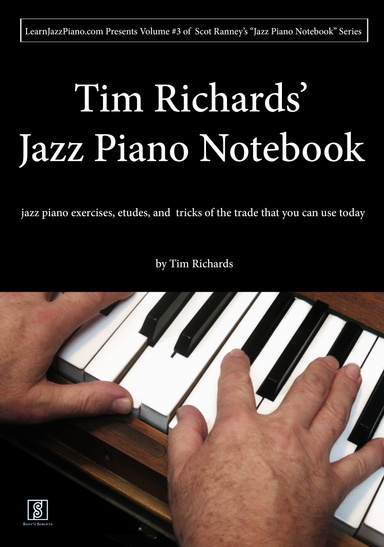
Volume 3 contains 12 jazz piano exercises and explorations by the acclaimed jazz piano educator, pianist, author, and recording artist Tim Richards.
Tim wrote the well known "Exploring Jazz Piano" and "Improvising Blues Piano" books and has several others to his name.
Tim has a new book out Beginning Jazz Piano (Pts 1 and 2)
Many of Tim's books now come with free access to interactive sheet music ONLINE, which permits slowing down of the backing and performance tracks, as well as the option to loop passages for practice purposes.
Tim now also has online VIDEO courses for his books, including Beginning Jazz Piano, Improvising Blues Piano and Exploring Jazz Piano Vol 1:
buy pdf version Tim Richards' Jazz Piano Notebook Volume 3 -
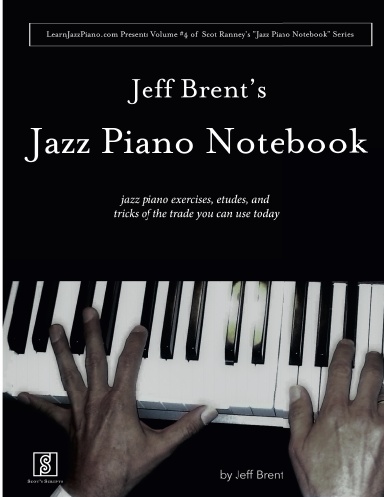
Volume 4 is by Jeff Brent, a jazz pianist, composer, teacher, and author of "Modalogy" and other acclaimed jazz theory and education books. In this book Jeff shares detailed analysis of transcriptions of live performances. He covers everything from the shape of the songs to the tricks and licks he uses in improvised lines to the ideas behind his lush chord voicings.
Most Recent Discussions
Articles
Piano for Adoption Scam
Aprender Jazz en Piano
BEWARE: FREE BABY GRAND PIANO SCAM
Oh Tannenbaum for Jazz Piano
Volume 5 of the "Jazz Piano Notebook Series" is Available!
LearnJazzPiano.com File Downloads News
more...
Top Sheetmusic Picks
Jazzy Christmas Arrangements
Cocktail Piano
Best Songs Ever, 6th Edition
Christmas Medley
Moana Songbook
Late Night Jazz Piano
Jazz piano education is cool.

Rock on. Follow your passion.
Sign In
LearnJazzPiano.com Copyright © 1995-2026 by Scot Ranney • website software and design by scot's scripts
LearnJazzPiano.com is For Sale - Serious Inquiries Only