Sounds clips posted: please critique
i have posted a couple of tunes on my sound click website. can you pop over there to listen and tell me what you think? https://www.soundclick.com/bands/7/tomrush.htm
sound click is a free service where you can upload mp3 etc... pretty cool.
-tom
There are no comments, leave a comment.
i'll try again tomorrow:)
i'll post another message when they are working. did you try the lo-fi streaming?
the blues is the stronger of the two tracks but there are some nice moments in both. i think the main thing to work on at the moment is the rythm of your right hand lines. try and work on 'pre-hearing' your phrases. sometimes it sounded a little like you were 'finger playing'. what i mean by that is you are playing something using the 'correct' scale but the rhythmic aspect of the line is not definite enough. this can happen when you aren't hearing how you want your line to go. a good tip to help this is to sing while you are playing. even if the pitches are all over the shop it should result in more rhythmically secure lines.
i did like the way that you aren't afraid to leave space in your solos and you get a really nice groove going in the heads of the blues. thanks very much for posting your files and i look forward to hearing more of your stuff in the future....
thanks for listening. it's really encouraging to hear comments like "you are starting to get it together "
actually no i'm not playing bass pedals, and to be honest there are few organ players that play anything but percussive notes on the bass pedals, although the greats, joey d, jimmy, groove etc... could all play bass lines with the pedals. nope i play lh bass.
"i think the main thing to work on at the moment is the rhythm of your right hand lines"i know what you mean, but i'm at a loss of how to practice that daily. do you think it would help to always sing along, because i definately do sometimes. when you say precise rhythm do you mean like i'm rushing or dragging inconsistently, because i do...
what can i do to work on prehearing? i know what you mean by prehearing because i do prehear occasionally, very rarely though.
thanks again!
-tom
3. it is a function of language. quick! complete the following sentence: "i saw a dog in the park ..."
ask a hundred people you'll get a hundred different answers but they'll be speaking who they are. what all have in common is that the completion of the sentence is in english, it's grammatically correct and it says something.
the beginning of a phrase points the way to the ending of the phrase.
4. it's about singing.
creating melodies using "the suggestive method"
the natural path to melodic construction.
https://www.jeff-brent.com/lessons/suggest.html

also, make sure to nail the head of a tune. if you play with it too much, (take liberties) it can sound like you don't know it:)
i don't think you were necessarily rushing or dragging, but a few notes were a little out of place - making your line or idea sound ambiguous - like you were not sure about what you were trying to play - hence the "prehearing"
all in all, i really enjoyed it:) let us hear more!
for example, try an exercise like this:
play a c major scale, two octaves, in 16th notes. accent every third note, regardless of where it falls on the beat, but keep the feel 16th notes (don't slip into a triplet feel).
it's amazing how difficult a simple sounding task like that is.
Scot is available for skype jazz piano lessons (and google hangouts, phone call, etc...)
Use the contact link at the top of the page.

by Scot Ranney on 02/19/2005, 19:26
i often think that when you first start trying to improvise, everything is so difficult. as you continue to improve you find new things to work on that are difficult and if you're not careful, you can get to the situation that you think it's not enough if you are playing something that is easy. in some kind of bizarre paradox, your 'comfort' zone becomes playing on the very edge of what you are capable of. i don't know if that is a factor in your playing but it's good general advice to remember that playing music should be easy and if you easily execute an idea, it is because you have mastered the necessary musical and technical demands to do so. something simple perfectly executed will always sound better than something more complex that is only approximated. i always think the main difference between people who can really play and those who are struggling is that good players consistently nail stuff whereas the struggling player 'almost' and 'kind of' hits stuff. make it a habit to play a lot of things in your solos that you can execute perfectly. that doesn't mean that you shouldn't practice things you can't do, but you should always spend some time each day playing as if you were in a performance situation and wanting to sound as good as possible. the reason for this is that you want to get into the habit of playing things that sound good and get used to feeling what it is like to play well. on stage, we tend to end up playing what we are used to - if all you are used to is playing lines you can't quite nail yet then that is what you will sound like. if, on the other hand, you are used to playing solos where you can nail the vast majority of the lines then that is what you will play on the gig.
some things that might help:
1. make sure that when singing along, you are actually trying to play what you sing, not singing what you are playing.2. to practice pre-hearing ideas it can help to restrict yourself to a small number of notes - maybe just chord tones or the first couple of notes of the scale. you said that you have experienced pre-hearing on occasion so you will know what you are trying to achieve. once you can hear your ideas with these notes, you can gradually expand the number of notes you are using.
hope you find some of this useful. stick with it, you're on the right lines.
Are you in the Pacific Northwest looking for a jazz jam? Check out our weekly Bellingham Jazz Jam!
Jazz Piano Notebook Series

Volume 1 of this educational jazz piano book contains 15 jazz piano exercises, tricks, and other interesting jazz piano techniques, voicings, grooves, and ideas Scot Ranney has picked up over decades of playing on stage.
Being a pro jazz pianist requires good ears, experience, and a bag of tricks that create the kinds of sounds people expect to hear from a jazz pianist. The entries in this book will give you some of those tricks.

"Latinesque"
Volume 2 has 14 jazz piano exercises and tricks of the trade, and quite a bit of it is Calypso jazz piano related material, including some Monty Alexander and Michel Camilo style grooves. Jazz piano education is through the ears, and books like this help connect what you're hearing to what you want to play.
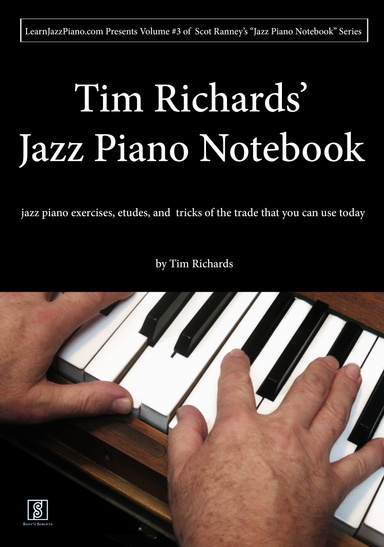
Volume 3 contains 12 jazz piano exercises and explorations by the acclaimed jazz piano educator, pianist, author, and recording artist Tim Richards.
Tim wrote the well known "Exploring Jazz Piano" and "Improvising Blues Piano" books and has several others to his name.
Tim has a new book out Beginning Jazz Piano (Pts 1 and 2)
Many of Tim's books now come with free access to interactive sheet music ONLINE, which permits slowing down of the backing and performance tracks, as well as the option to loop passages for practice purposes.
Tim now also has online VIDEO courses for his books, including Beginning Jazz Piano, Improvising Blues Piano and Exploring Jazz Piano Vol 1:
buy pdf version Tim Richards' Jazz Piano Notebook Volume 3 -
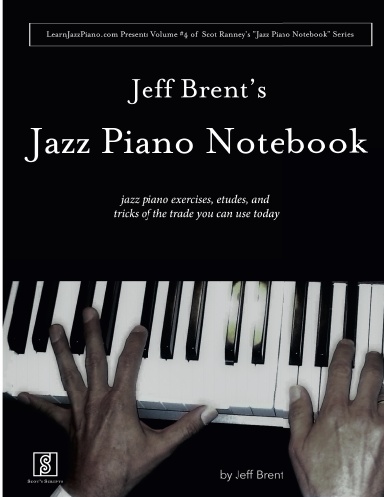
Volume 4 is by Jeff Brent, a jazz pianist, composer, teacher, and author of "Modalogy" and other acclaimed jazz theory and education books. In this book Jeff shares detailed analysis of transcriptions of live performances. He covers everything from the shape of the songs to the tricks and licks he uses in improvised lines to the ideas behind his lush chord voicings.
Most Recent Discussions
Articles
Piano for Adoption Scam
Aprender Jazz en Piano
BEWARE: FREE BABY GRAND PIANO SCAM
Oh Tannenbaum for Jazz Piano
Volume 5 of the "Jazz Piano Notebook Series" is Available!
LearnJazzPiano.com File Downloads News
more...
Top Sheetmusic Picks
Jazzy Christmas Arrangements
Cocktail Piano
Best Songs Ever, 6th Edition
Christmas Medley
Moana Songbook
Late Night Jazz Piano
Jazz piano education is cool.

Rock on. Follow your passion.
Sign In
LearnJazzPiano.com Copyright © 1995-2026 by Scot Ranney • website software and design by scot's scripts
LearnJazzPiano.com is For Sale - Serious Inquiries Only