An Inspiring Post
"if your aim is simply playing the piano, i cannot see why you should not – in principle - play anything that you set your mind to.
i certainly have taught the “virtuoso” repertory (whatever that might mean) to many over 40s (chopin etudes, beethoven sonatas, scarlatti sonatas, liszt etudes and the like). most importantly they have learned it.
however your advisee may have had something else in mind. perhaps she was referring to making a career as a classical pianist. in that case she may be right: the odds are very much against you. but this is simply out of market considerations, not skill considerations.
but if all you want is to play the piano as an amateur, the only real limit you will have is death (so much music, so little time…)
one last word. if your evaluator is of such an opinion, will that not taint her choice of a teacher for you, and what this teacher is prepared to teach you? you may then face a huge external limitation.
this is my suggestion.
make a list of 100 pieces you would like to play. do not worry about degree of difficulty. the may be very easy, or impossibly difficult. but they must be pieces that you would love to play. for instance, in my own repertory i have many pieces that are ridiculously easy – even a total beginner could master them in their first lesson, but they are such beautiful pieces that their “easiness” is largely irrelevant (for instance, “fur alina” by arvo part is one such piece – hauntingly beautiful and yet just one page long and when you look at the score you cannot believe that such an easy piece can sound so amazing). likewise you should not be afraid of “virtuoso” pieces – as long you really want to play them. for instance i was never interested in playing any of the trascendental studies of liszt apart from gnomenreigen which i always loved. so i do not play them (apart form gnomenreigen). the repertory is far too large and we cannot waste time on pieces we do not really like. this does not mean that i am not appreciative of “feux follets”, or “mazeppa”, which i like to listen to and to watch performed by other pianists. however i was never really interested in playing these pieces.
so make your list, and aim to be playing these 100 pieces in 5 years time. this is not unreasonable: with the right approach any one can master 20 pieces in a year (that’s less than two pieces a month), and will give you 3 – 4 hours of uninterrupted playing: enough for 3 or 4 recitals!
next you must ask your teacher to help you in learning these pieces. this means that she must order these 100 pieces in a progressive order of difficulty, from easy to difficult, so that you start by learning the easy pieces, and by doing so you will gradually acquire the technique needed for the next piece. in this way, from the very beginning you will be acquiring repertory.
of course you may change your mind in regards to these pieces at any time, and replace them with others. our tastes change, and also we come to know pieces that we were unaware before.
a further advantage to this approach is that since you have clear goals, you will be able to evaluate your progress (or lack of) by checking at the end of each year what you have accomplished so far.
now if your teacher is not prepared to go along with such a plan and is not prepared to help you achieve it, i would seriously consider changing teachers."
danny
There are no comments, leave a comment.
now what struck me about this was: what is the point of this kind of programme? why is it so classically - slanted? are there likely to be any 2 or 3 year olds watching, who are inspired to put down their toys and say 'wow, i'd better start learning now or it will be too late'. maybe it will panic a few obsessive parents into reaching for the yellow pages to find a piano teacher quick sharp. but really, this kind of thing can only be discouraging. the most important thing is that people are encouraged to learn whatever the age, whatever the time they have to spare, whatever their talent. to enjoy it.
it's a symptom of the 'star culture' times we live in. the 'i'm a nobody so why bother' culture that pervades society, encouraged by our celebrity-hoisting media.
also... this kind of relates to what i'm harping on about in another thread. picture this: a 12 year old with perfect technique. amazing to hear. but you need real world experience to draw on to find things to play about and express. in a way the older you are the more source material you will have for musical expression.
the programme focussed on what it is like to attempt to become a concert pianist.
when i started college, i had played jazz and pop most of my life and had only seriously studied "classical" for two years prior to entering music school. the piano teacher i was assigned was quite renowned as a performer but even more so as a teacher. she said i had to attend a "master class" twice a month, where her students all perform pieces they are studying. she said it was mostly teenaged girls aged 12-14. i was prepared to be bored.
much to my amazement and embarrassment, these young girls were playing rings around me! they all had won competition after competition.
many years later i ran in top one of them at a gig i was playing. to my amazement, she said she no longer plays and doesn't even have a piano....hmmmm...isolated case? i'm not sure, i see this sort of thing quite often in competitive sports as well...
i guess the point is to enjoy the journey of discovery - take your time and enjoy life
"stage mothers" who push their children to practice music (or anything for that matter) against their will are a sick bunch. they try to vicariously fulfil their lost hopes and dreams through their children in spite of their children's own wishes.
the vast majority of them end up either completely alienating the child (thereby accomplishing exactly the opposite of their "great plans") or if they succeed in turning their offspring into "child stars" the kids have a high risk of ending up like mozart or michael jackson or jesus.
i can't tell you how many adults have said to me "my parent's forced me to take music lessons when i was young - and i hated it! but now i sure wish i'd stuck with it".

but i'm a very firm believer that you can start at virtually any age and progress to an extremely high level of playing providing you approach it correctly and scientifically.
Scot is available for skype jazz piano lessons (and google hangouts, phone call, etc...)
Use the contact link at the top of the page.

by Scot Ranney on 07/12/2005, 09:37
if anyone's interested, i might be able to find the torrent that i downloaded the program from in the first place.
and yes, dr. john did switch to piano as his primary instrument after his finger was shot off/injured in an accident. he might have been playing piano before that though. i do know that the reason he didn't play more in the first place was that he was scared that he wouldn't measure up to all the legends he hung around: fats domino, professor longhair, james booker (genius who should be listened to more often), huey smith, allen toussiant, ect.
danny
freakin babies i sse em stare at me from the crib. i say "oh yeh" i pick em put em down at the piano and say "ok you lil shit" out play me"
they pee there pants every time. my advice... save face and humilation
start older like i did.
Are you in the Pacific Northwest looking for a jazz jam? Check out our weekly Bellingham Jazz Jam!
Jazz Piano Notebook Series

Volume 1 of this educational jazz piano book contains 15 jazz piano exercises, tricks, and other interesting jazz piano techniques, voicings, grooves, and ideas Scot Ranney has picked up over decades of playing on stage.
Being a pro jazz pianist requires good ears, experience, and a bag of tricks that create the kinds of sounds people expect to hear from a jazz pianist. The entries in this book will give you some of those tricks.

"Latinesque"
Volume 2 has 14 jazz piano exercises and tricks of the trade, and quite a bit of it is Calypso jazz piano related material, including some Monty Alexander and Michel Camilo style grooves. Jazz piano education is through the ears, and books like this help connect what you're hearing to what you want to play.
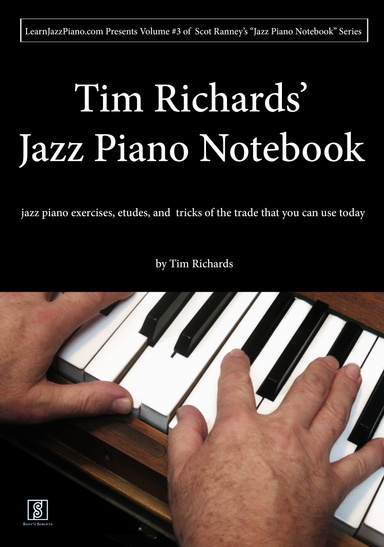
Volume 3 contains 12 jazz piano exercises and explorations by the acclaimed jazz piano educator, pianist, author, and recording artist Tim Richards.
Tim wrote the well known "Exploring Jazz Piano" and "Improvising Blues Piano" books and has several others to his name.
Tim has a new book out Beginning Jazz Piano (Pts 1 and 2)
Many of Tim's books now come with free access to interactive sheet music ONLINE, which permits slowing down of the backing and performance tracks, as well as the option to loop passages for practice purposes.
Tim now also has online VIDEO courses for his books, including Beginning Jazz Piano, Improvising Blues Piano and Exploring Jazz Piano Vol 1:
buy pdf version Tim Richards' Jazz Piano Notebook Volume 3 -
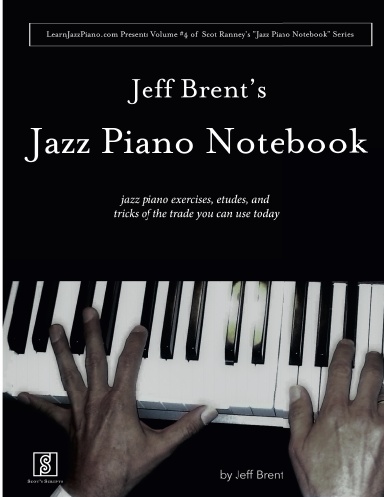
Volume 4 is by Jeff Brent, a jazz pianist, composer, teacher, and author of "Modalogy" and other acclaimed jazz theory and education books. In this book Jeff shares detailed analysis of transcriptions of live performances. He covers everything from the shape of the songs to the tricks and licks he uses in improvised lines to the ideas behind his lush chord voicings.
Most Recent Discussions
Articles
Piano for Adoption Scam
Aprender Jazz en Piano
BEWARE: FREE BABY GRAND PIANO SCAM
Oh Tannenbaum for Jazz Piano
Volume 5 of the "Jazz Piano Notebook Series" is Available!
LearnJazzPiano.com File Downloads News
more...
Top Sheetmusic Picks
Jazzy Christmas Arrangements
Cocktail Piano
Best Songs Ever, 6th Edition
Christmas Medley
Moana Songbook
Late Night Jazz Piano
Jazz piano education is cool.

Rock on. Follow your passion.
Sign In
LearnJazzPiano.com Copyright © 1995-2026 by Scot Ranney • website software and design by scot's scripts
LearnJazzPiano.com is For Sale - Serious Inquiries Only