voicings
There are 5 comments, leave a comment.
yes, e dim has the same notes as c7b9 (without the c). the trick to diminished chords is to realize that there are really only two diminished chords (a 1/2 step apart). i think of a c7b9 as an e diminished chord with the c added in (and you don't really even need the c for rootless voicings).
basically, i don't think it matters how you think of it, as long as you get the right sound. you will need to discover for yourself how to "think of it".
some random thoughts on voicings:
keep it simple, and use fewer notes.
leave a gap between the lowest note and the next note (especially if you are lower on the keyboard). for example, on a diminished voicing play the low note and then skip a note in the dimished chord before the next note.
altered chords tend to have b9,#9,b5,or #5. generally i use either (b5 and b9) or (#5 and #9). some good choices then for a calt7 are:
bb db e ab c (b5 and b9 ) (this doesn't have a large gap between the first two notes, so it is best higher on the keyboard).
or
e bb c eb ab (#5 and #9 )
one of my thoughts on voicings is to look for a major 7th interval in the notes. i think the presence of a major 7th gives a nice sharp "jazzy" sound without being too dissonant. thus, here are some examples of simple (one hand) voicings i like:
c7 : e bb eb (this has a #9)
or bb e a (has the 13th)
cmin7: eb bb d (has 9th)
cmin7b5: gb bb eb f (has 11th)
cmaj7: c a b e
you notice that each of these chords has a major 7th interval in them somewhere.
the point of this is that when you first learn chords it can seem at first like "anything goes" because there are so many options. i personally found this concept of looking for the major 7th as the most useful in understanding why you can add a #9 or 13th to a c7, a 9 to a cmin7 and a 11 to a cmin7b5.
maybe this is all more than you wanted to know. basically, i would experiment around and find voicings you like for different chords and use just 1 or 2 different voicings for each quality of chord. if it sounds good to you, you don't need a theoretical argument to play it.
are you doing group playing or solo playing?

yes you are right. no wonder my playing has been missing something! (just kidding).
ex: gdim (g bb db e) to me would be the upper reaches of a c7b9
(c e g bb db)
take the very common progression c c#dim dm7 g7. the c#dim which originally just appears to be some scrunched up notes that facilitate the passage from the i chord to the ii chord, is actually the upper part of an a7 b9.
looked at this way we see the entire progression as i vi ii v, the diminished being a substitution.
when analysing the music of bach, i used to get very confused with the diminished chords until i started seeing them as parts of dominant chords. this cleared up some problems for me. it also gave me added respect for how far ahead of his time he was. you don't normally think of dominants with flat 9s as part of the music of the early 1700s.
Are you in the Pacific Northwest looking for a jazz jam? Check out our weekly Bellingham Jazz Jam!
Jazz Piano Notebook Series

Volume 1 of this educational jazz piano book contains 15 jazz piano exercises, tricks, and other interesting jazz piano techniques, voicings, grooves, and ideas Scot Ranney has picked up over decades of playing on stage.
Being a pro jazz pianist requires good ears, experience, and a bag of tricks that create the kinds of sounds people expect to hear from a jazz pianist. The entries in this book will give you some of those tricks.

"Latinesque"
Volume 2 has 14 jazz piano exercises and tricks of the trade, and quite a bit of it is Calypso jazz piano related material, including some Monty Alexander and Michel Camilo style grooves. Jazz piano education is through the ears, and books like this help connect what you're hearing to what you want to play.
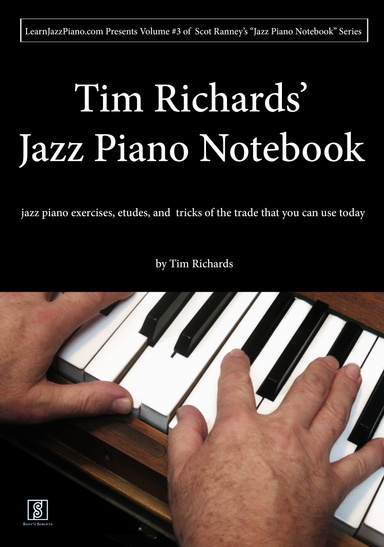
Volume 3 contains 12 jazz piano exercises and explorations by the acclaimed jazz piano educator, pianist, author, and recording artist Tim Richards.
Tim wrote the well known "Exploring Jazz Piano" and "Improvising Blues Piano" books and has several others to his name.
Tim has a new book out Beginning Jazz Piano (Pts 1 and 2)
Many of Tim's books now come with free access to interactive sheet music ONLINE, which permits slowing down of the backing and performance tracks, as well as the option to loop passages for practice purposes.
Tim now also has online VIDEO courses for his books, including Beginning Jazz Piano, Improvising Blues Piano and Exploring Jazz Piano Vol 1:
buy pdf version Tim Richards' Jazz Piano Notebook Volume 3 -
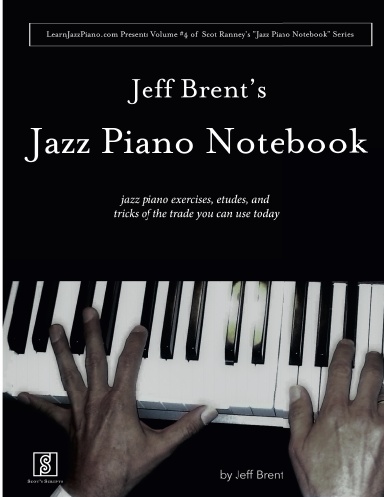
Volume 4 is by Jeff Brent, a jazz pianist, composer, teacher, and author of "Modalogy" and other acclaimed jazz theory and education books. In this book Jeff shares detailed analysis of transcriptions of live performances. He covers everything from the shape of the songs to the tricks and licks he uses in improvised lines to the ideas behind his lush chord voicings.
Most Recent Discussions
Articles
Piano for Adoption Scam
Aprender Jazz en Piano
BEWARE: FREE BABY GRAND PIANO SCAM
Oh Tannenbaum for Jazz Piano
Volume 5 of the "Jazz Piano Notebook Series" is Available!
LearnJazzPiano.com File Downloads News
more...
Top Sheetmusic Picks
Jazzy Christmas Arrangements
Cocktail Piano
Best Songs Ever, 6th Edition
Christmas Medley
Moana Songbook
Late Night Jazz Piano
Jazz piano education is cool.

Rock on. Follow your passion.
Sign In
LearnJazzPiano.com Copyright © 1995-2026 by Scot Ranney • website software and design by scot's scripts
LearnJazzPiano.com is For Sale - Serious Inquiries Only