How busy is your left hand?
do you then do heavy duty walking of the bass? or just simple stuff. how busy does it have to be to sound good? or to say it differently, how important is it to have a "real" sounding bass player?
or is this a waste of energy since the bulk of your audience will not notice or even care?
now let's reverse the situation. guitar player is now comping (hard to imagine they will let you) and you are now improvising on the rh. what's happening to the lh at this point. obviously you still need some bass sounds. what's the proper thing to do here? same as above? or even simpler bass?
now let's use another situation...the sax player is comping...hey wait a minute...he can't do that. ;-) just kidding. just the first two situations please.
thanks.
There are 77 comments, leave a comment.
by robert nixon
a great deal has been written about the subject of piano technique, a survey of which can easily prove very confusing for the student or teacher. apart from the intrinsic difficulty of describing physical actions by means of a written text, much of the published material is contradictory in both details and principles. also, modern literature on piano technique is often scattered with quasi-scientific terminology, making it even more difficult to assess the soundness, or lack thereof, of its contentions.
traditionally, the essentials of keyboard technique are equality and independence of the fingers. it seems difficult to conceive of a plausible system that does not consider this foremost. yet many modern works on technique argue that the co-ordination of the arms, or even the shoulders, are more important than training the fingers. ultimately, the piano is played with fingers (unless you happen to be playing tone clusters in henry cowell!)- they are in contact with the keys, and it is by their action that the keys are played. it is difficult to see how the arms and shoulders, which are quite a distance from the keys, and are not in physical contact, have very much to do with piano playing at all. they merely position the hand in the appropriate place on the keyboard- a rudimentary function. but it is finger action which produces velocity, evenness, precision, clarity of articulation, dynamic control, etc. - in short those qualities which distinguish the technically good pianist from the bad, and often mean all the difference between passing and failing piano diploma examinations.
the purpose of this article is to outline a time-efficient, simple, and certain way of developing a quality finger technique. the approach outlined is by no means an original or unorthodox one; similar exercises are found in a great many nineteenth century methods, as well a several early twentieth century technical works. but it is likely to seem new, even radical, to many student and teachers - and it can be guaranteed to improve your playing!
an overly busy bass player can jum up the mix big time. often it's enough to hit the root on the one and a lead tone into the next root on the four.
les is mor

the exercise
firstly, position your right hand thumb on g#. now position your second finger on b, the third on d, the fourth on f, and the fifth on g# (the one an octave above where the thumb is). you should now be covering a diminished seventh chord. position the left hand so that it is covering the same chord the bass. push down all the notes in the chord, ensuring that the fingers remain as curved as possible, the back of the hand flat (so a pencil would balance there without falling off), and the forearms are perfectly horizontal and perpendicular to the keyboard, with no bending in the wrist. this position is to be retained throughout.
depending upon the size of your hand, this may seem like something of a big stretch, especially when a sound hand position (as described above) is retained, which is essential. however, stretching this kind of chord is a fairly standard requirement in all composers from bach onward. the problem is generally not that the hand is too small, but rather a lack of conditioning. as anyone who has tried yoga, karate or gymnastics will know, flexibility is something that can be learned. so the more difficult it is, the more important you should persist with it!
now, keeping all other fingers, pushed down, play with the fifth finger, repeating its note (a g# in each hands), with an even rhythm at a moderate tempo (not very quickly). play as loudly as possible, but ensure that no arm movement whatsoever is engaged, and ensure that the hand position remains correct (curved fingers, etc.). repeat for as long as your concentration, patience and endurance permit (this could be between one and ten minutes).
the purpose of this exercise is:
- to strengthen the fifth finger in both its downward (sounding) and upward (articulation) aspects. to render its action independent of the other fingers, and independent of movement of the arm or wrist; and, to develop orientation, sensitivity and control in the fifth finger.
now, keeping the hands positioned over our g# diminished seventh chord, our attention moves to the fourth finger. again, keep each finger firmly pushed down, except for the fourth. as before the fourth finger now repeats its note (f in the right hand and b in the left hand), evenly, as forcefully as possible, and at moderate tempo. repeat for anywhere between one to ten minutes, depending upon the level of fatigue you experience and the extent of your pianistic ambitions! if you intend to perform the rachmaninoff's concerto no.3 at some point your future career, practise for longer!
the next step is to employ precisely the same procedure with the third finger. this is normally not as difficult as the fifth and fourth fingers, and this stage of the exercise can be viewed as a chance to allow the weaker fingers to recover. it is recommended that less time and effort be expended on the third finger.
while these three steps may have been fatiguing (indeed, should have been fatiguing if carried out for sufficient time and with sufficient intensity), it is unlikely that any co-ordination problems would have arisen. the following, and concluding, two steps may be difficult to co-ordinate - about 90% of students seem to have some initial difficulty, but is soon overcome.
the hands should still be positioned as described earlier, each covering the five note g#-b-d-f-g# chord. firmly depress all fingers, except the fifth and third, and keep them depressed for the duration of this stage of the exercise. now play with the third and fifth fingers (a g# and d in each hand), at the same time, as a double note. repeat this double note, evenly, as forcefully as possible, and at a moderate tempo. ensure that the double note is struck exactly simultaneously, and that none of the other fingers move at all. special attention must be paid to keeping the fourth finger still while the third and fifth operate. similarly, the arm and wrist must remain perfectly still.
the final stage of the exercise is to apply the same procedure, but playing the double note of the second and fourth fingers, while all the other fingers remain firmly depressed, as before.
for all five stages of the exercise, the following time distribution may be recommended:
fifth finger 5 minutes
fourth finger 5 minutes
third finger 2 minutes
third and fifth fingers 4 minutes
second and fourth fingers 4 minutes
this scheme will take a total of only twenty minutes (it could be repeated several times, if more time is available). in terms of developing the fingers, twenty minutes expended as suggested above is equivalent to about three hours of scale playing.
what will this exercise do for me?
the exercise described above, though extremely simple in concept and limited in material, contains within it almost all of the physical mechanisms which differentiate between good and bad technique. the effect of this exercise include:
the muscles which operate the fingers are strengthened, especially those of the fourth and fifth fingers. the more equal the strength profile of the fingers, the more even the playing.
the tissues that connect the fingers, and reduce their mobility, are rendered more flexible.
the fingers are taught to produce great tone without engaging any arm or wrist movement. the greater the economy of movement, the more efficiently and quickly any action is performed.
the messages from the brain to the fingers are rendered more controlled, and spasmodic finger movements are reduced or eliminated. this factor is most obvious in the final two stages of the exercise in which double notes are played. initially, it is difficult to send a message from the brain for the third and fourth fingers to move, without the fourth also moving (or for the second and fourth fingers to move, without moving the third). the neural pathway, unless developed through this type of exercise, remains confused and inefficient.
in playing terms this all means greater velocity, clarity of articulation, precision, evenness, and strength of time. most pianists who aim at being serious performers or teachers will agree that these are all qualities of which one can never have too much at one's disposal.
making the exercise more interesting
one of the most attractive features of the exercise outlined above is that because of its extremely repetitive nature, one can turn one's thought to other subjects. for example, read a book while practising the exercise! there are many stories about great pianists in the past who used to read while practising. this includes liszt, who educated himself by reading shakespeare and goethe (among other authors) while practising, almost certainly using predominantly the type of exercise outlined here. henselt reportedly read the bible while practising exercises, which he did for up to sixteen hours a day - when he got to the end, he would simply go back to the beginning and start all over again. saint-saens did his piano practice while reading the daily newspapers!
an obvious suggestion for making the exercise described in this article much more interesting, and also more useful, is to transpose the diminished seventh chord chromatically, moving through several different diminished seventh chord positions. however, care must be taken that there is no hesitation or muscular relaxation in making these changes of position.
the final suggestion is one that is intended only for ultra-ambitious pianists- instead of playing with a five note diminished seventh chord (g#-b-d-f-g#), try a five note augmented chord (e.g. f-a-c#-f-a). the thumb is thus a major tenth away from the fifth finger, and a major third separates each finger. needless to say, care must be taken to avoid overstrain - there must be some fatigue, but not to the point of excessive pain. this applies equally to everything suggested in this article.
conclusion
it is beneficial if pianists can divide their practice time into two completely separate aspects: rehearsal and training. 'rehearsal' is learning the repertoire, and trying out different kinds of interpretation and presentation. in rehearsing, all thought of technique should be forgotten, because it should already be 100% secure.
the other aspect of practice is 'training.' this involves developing the mechanism and co-ordination necessary to play the instrument. this must be a substantial proportion of the practice time, and the more advanced the pianist, the greater the proportion of practice time that tends to be spent on the 'training' aspect.
the exercise program outlined in this article falls, of course, into the 'training' category. there are undoubtedly many readers who will find it a strange and new approach, but also a few who will immediately recognise the origin of many of the ideas here in various respected technical methods, mostly of nineteenth, or early twentieth, century origin. but with piano playing, where most of the music we play is more than a hundred years old, the old way is sometimes the best.
jv'
7, did you come up with this, i've never seen it.(?)
one needs to have fairly relaxed muscles and not be to mentaly hung up on what notes to play. therefore one has to practice slower before they can speed things up.
kenny warner has a bit in his book that talks about how anybody with normal reflexes and normal flexibilty can wiggle their fingers on the keys as fast as anybody else can.
another problem i see is when somebody has the bad habit of collapsing
their first knuckle. that will cause the fingers to linger to long on each key.
1. "people time". stan getz (tenor sax) and kenny barron (piano). 1990 or 91.you have here a great variety of tempos, arrangements and styles. i love their latin-flavored version of "i got you under my skin". barron demonstrates an interesting interplay between right and left hands that produce an unexpected rhythm line.
2. "intermodulation" and "undercurrent". two great albums by the bill evans / jim hall duet recorded in the sixties. if you listen to the version of the same standard mentioned above, "i got under my skin", (from "intermodulation") you will note that bill evans play only with his right hand when it is time to improvise for him. when comping, he uses both hands, but he doen'y play walking bass lines, just rhythm blocks.
i think the most important thing in duo situation is always be aware of how many things are happening every second. so, you have to be trying to sound interesting, but without be in the soloist way when you're comping. from my experience, i can say you achieve ths goal as your experience playing in duo situation incresaes.
all the best
betogar
https://www.pianoforum.net/smf/index.php?phpsessid=9e5a9e4a00f912daea3f59a3e128db6b
because i've played for years by myself, i tend to cover the entire keyboard - not necessarily walking, but just bass notes with arpeggios. i rarely "stab" chords with the left hand. so, the guitar player often comps chords and leaves the bass to me. when it works we trade off so that one of us is filling in the lower octaves.
i think "catalyst of the muse" would make a great t-shirt...
followup please...if "les is mor", then in what situations do you usually walk the bass? solo? or use it in the above cases i mentioned but sparingly?
i'm acquiring all these fancy skills but am not clear on when to use them.
all the best.
kjell
file:///users/kjellgierstae/desktop/how%20many%20hours%20i%20need%20to%20practise%3f.html
keep in mind that hitting the root on the one of the chord and a leading note on the beat just before the next root is already a form of walking bass.
and every so often you can sneak in a chord stab somewhere around beats 2 & 3, whenever the mood hits you.
kjell
https://www.pianostreet.com/smf/index.php?action=profile;u=1627;sa=showposts;start=800
it's great that the bass notes on a rhodes sound like a bass.
listen to the half note "2 beat" bass style played on the head of "autumn leaves." then he walks during the solos. this is how i play my left hand when playing a rhodes in a duo or a keyboard that can split bass.
i also like that kenny barron style walking bass ( 1 5 8 chromatic approach note)( 1 5 8 5 9 b9 8 chromatic aproach note) and do it on acoustic rather than step wise walking wiich sounds better on rhodes.
on ballads i play the two beat style and also a lot of single low root followed by the same root an ocatve higher in half note rhythm. i add a little bit of bass fills too, usualy around beat 4 (listen to errol garner's bass players on al of the ballads). this is style that mal waldron also uses heavily when accompanying singers. this works well on acoiustic piano too.
on bossa novas i play root then 5th ( or root root) in half note rhgythm. i avoid the un-authentic overly busy song for my father bass line. it also helps if you leap down to the fifth rather than up to the 5th. it sounds more like the brazilan accent on 3 that way (for them it's a 2 in cut time).
on acoustic piano i don't like alking unless it's a great grand piano with great bass notes. on acoustic i play broken bass lines or half note style (waldron). i also do shell voicings (bud powell) and of course stride, both straight and syncopated.i also do a lot of left hand arpeggio style on ballads. i combine and mix up all the textures i know on acoustic.
https://www.towerrecords.com/product.aspx?pfid=3243181
correction:
"on acoustic piano i don't like walking unless it's a great grand piano with great bass notes."
i do like the kenny narron type hopping bass line on acoustic, the stepwise walking bass lines can easily sound corny on an acoustic.
kjell
i've been practicing with creative chord rhythmic stabbing on rh or just football chords, depending on the moment, in coordination with changing patterns on the lh. i actually transcribed some bass players and doing the lines on the lh.
i actually use these sophisticated bass lines when recording. of course i'm doing one track at a time so i can don't have to worry about hand independence here. but in a live situation, this is hard to do. i am practicing so hard i can actually solo now while doing this. now, i'm wondering if i am overdoing it and maybe concentrating on the wrong things.
from what 7 and you are saying, it sounds like i need less than what i am currently practicing?
and 7, i assume that when you mean root and approach note, you're still talking quarter notes here right? i misunderstood you the first time. i presume that in a duo, the lh has to generate the pulse of the music like a real bass so quarter note bass is important. is this correct?
7, thanks to your website, i learned to walk beginning with your lessons on bass walking and it's been awhile now of practicing this.
btw, to make my approach clear here, i have an s90es. i usually split the keyboard with bass on the left, and varying instruments on the right. the s90es has some pretty good drum arpeggios for jazz so i can sound like a trio just on my own.
jazz+, do you provide the drums too when you duo?
thanks much.
thank you for the honorable mention:
https://www.jeff-brent.com/lessons/lessonshome.html
thanks a lot, jazz+. i'll come back to tell you about my progress!
basic 2 beat bass style example:
single note bass root on beat one.
5th on beat three or a chromatic note approaching the next root from either above or below the next root.
as i said, that is how the bass is done on autumn leaves the first two choruses on that famous miles davis recording i linked you to above.
no, i don't do the drums, although abersold has a few drums only cd that could possibly work.
good luck!
https://www.amazon.com/gp/product/b000000ghb/103-7428658-1583844?v=glance&n=5174
its a lot of reading and i suggest you dont read every word as written in stone,but try to get the idea. my experience is that everybodys finger are strong enough,but we have to figure out how to use them in combination with the forearm,wrist and shoulder movements.
https://members.aol.com/chang8825/entirebook.htm
all the best
kjell
https://www.towerrecords.com/product.aspx?pfid=2794738
ps:
when playing in the half note bass style i anticipate beat one and beath three often, otherwise it doesn't swing much.
it is the "2 beat bass" style and it sounds hip because he frequently anticipating beat one and beat three by an eighth note! that is what makes "2 beat" bass swing hard.
https://www.towerrecords.com/product.aspx?pfid=3320612
https://www.towerrecords.com/product.aspx?pfid=3320612
i am agree with solart and this is why its completed wasted time to practise hanon in my opinion. if you dont lift your fingers but pushing them down when playing,the 4th finger have the same "power" as the other fingers. if you try this: hold your hand in front of you(in the air) pushing down the finger one by one starting with the thumb,(1) then 2,3 and when you do the 4th you will notice it is as flexible as the other ones.
here is a link about how to achive ultra fast speed
https://pianoforum.net/smf/index.php/topic,3371.msg30141.html#msg30141
all the best
kjell
kjell
1. forget all those deeply ingrained notions about slow practice. people wax lyrical about slow practice, but usually they have no idea of what it is all about. is slow practice important? certainly. but important for what? there are only two reasons to do slow practice and each reason requires a different kind of slow practice.
i. slow practice is essential to check your memorisation of the piece. please notice: it will not help you memorise the piece, it will simply verify if you did. basically you play slowly, very, very slowly. set the metronome at 32. then play each note every four beats of the metronome (you do not need to use a metronome, this is just to give you an idea how slow is slow). go even slower. stay 10 seconds on each note. you see, when you play this slow you destroy hand memory. there is no way you can trust your fingers to do the job. you must have a true, complete and exhaustive memory of all aspects of your piece if you are going to play this slow. you must know the harmony, the motif development, the form and structure, everything. so by playing this slow, not only you stop hand memory form interfering, as you give yourself enough time to recall all these different aspects of your piece.
if you find that you cannot do that – even though you can play the whole piece form memory at the correct speed – you have a problem. you will be relying completely on hand memory. that is when the black out occur, and you have of start again from the very beginning. so if you cannot play the piece form memory at a ridiculously speed, it is a sure sign that you have to work a lot, but a real lot more on your piece before venturing into performance. on the other hand, if you can play it slowly without mishaps, you can be confident that even if something goes wrong you will be able to swiftly recover.
in several threads people keep mentioning how rachmaninoff (an din some versions glenn gould) have been overheard practising excruciatingly slowly. and the implication is that this is the way they develop their exquisite touch and acquired their formidable technique. sorry. this is complete nonsense. they were simply testing their memory of the piece. no more no less. and it was not a regular thing either. they did it occasionally as a memory test. this is plain common sense. take the hammerklavier sonata. it takes over 40 minutes to play it at full speed. play it at this ridiculously slow speed, and you end up using ten hours just to get through it once. a good idea if you are going to do it one single time to check that your overall memory of the piece is fine. do it everyday as a practice routine and you will not have time not even to eat (besides i doubt very much that anyone in the universe would have the necessary powers of concentration). but humans are easily conditioned. they unquestioningly accept the most absurd propositions and will violently defend untenable positions simply because their teachers said so, or because they read in an interview that such and such famous pianist assured us all that this is what s/he did (and let us not forget that gelnn gould was renowned for being a prankster, so anything he said in interviews should be taken with a large pinch of salt).
ii. the second reason to do slow practice is to make sure (by performing it slowly) that you are doing the correct movement. this is what i call slow motion practice. this is far, far faster than the slow practice discussed above - and for which the correct movement has no relevance. this second kind of slow practice can be pretty fast, but it is always slower than the final speed of your piece. it is as slow as you can manage in order to have perfect accuracy and in your movements and not loose hand memory. this is a bit like tai chi speed. it is slow motion, but the complete movement is there. while the slow practice i referred to above is more like a series of snapshots.
this second kind of slow practice – slow motion practice – assumes and presupposes that you already can play the piece at speed; that you have already spent a sizeable amount of time investigating different movements/fingerings and that you have already arrived at your optimal technical solution.
the purpose of slow motion practice is to make sure that as you repeat endless times your passage/piece you only ingrain the correct movements/fingerings. it is as simple as that. as the famous reply of wilhelm backaus to an interviewer who asked him how come he never played any wrong notes: “i only practise the right notes”.
so now, you are going to slow down while keeping the same ideal movements as when playing fast. how are you going to figure out this ideal movement? we will get to that in a moment. the important point here is that slow motion practice cannot and should not be exploratory. that is, the worst you can do when faced with a new piece is to practise it slowly. why?
it seems reasonable that if you do not know a piece, you should approach it slowly, so that you can figure out how to play it. and what is the alternative? to play it at tempo? how are you going to do this if you do not know the piece?
so here is why, and here is how something that makes perfect sense can be utterly wrong. (after all the earth is not flat).
if you go to the music shop, buy your copy of a piece you have never seen before, rush to the piano and start to slowly work on it straight away, you will be doing all sorts of wrong movements, fingerings, etc. and because you are doing it slowly you are going to get away with it. unfortunately, these movements, fingerings, etc. will never work at speed. but your body does not know that. it just imprints all these inappropriate actions in your motor centres and there they stay forever. and as you keep repeating time after time slowly all these wrong movements, they get more and more ingrained.
why not use a metronome? make sure you go up just a notch, so that the increase in speed is almost imperceptible. by the time you get to half speed, you will have repeated slowly (and getting away with it) so many times the wrong movements that by then they will have become a) habitual; b) comfortable; c) natural. but as you increase the speed, those movements will start to become inadequate. at faster speeds you will not be able to get away with them anymore. in fact when i say faster speeds, i am talking about pretty slow speeds, speeds that are nowhere near the final speed of your piece. you have successfully created a speed wall. you can practice for as many hours as you please, you will never go beyond that limit speed that is nowhere near the final speed. yet people insist on using and suggesting just such a methodology to acquire speed in passages. it may make sense, but it cannot produce results.
but worse is to come. because now, if come across a good teacher who watches you play and can immediately pinpoint the wrong movements and direct you to the correct movements, you will be unable to do them, because the wrong movements have become a) habitual b) comfortable and c) natural. this means that you will be always fighting a battle you cannot possibly win. ultimately you will never be able to play the piece. yes, that is correct. you will have to give it up. so, go ahead, all of you who wish to learn rach 3 with 6 months of learning the piano without a (good) teacher. just do a lot of slow practice and you will get there! he he.
so what is the alternative?
2. when you come back from the music shop with your new piece, approach it the same way porcupines make love: carefully, very carefully. do not even think of rushing to the piano to sight-read it. this was understandable one hundred years ago, when sight reading was the only way to figure out what a piece sounded like. but today? get a cd of the piece and listen to it! then start working on the score. divide the piece in sections. figure out which sections are going to give you a lot of work. rewrite the piece separating the voices (if it has several voices). tap the rhythm, sing the several voices. do a harmonic analysis, work on the motifs. in short know your piece back to front without ever going near a piano. once this preliminary work has been done, then select a small section (depending on the piece this may mean just two notes) and finally go to the piano. but before playing it, rehearse in your mind how you are going to do it. feel the fingering you have decided on in your mind before actually doing it. then and only then, press the keys. in short, make sure you are never ever practising wrong. like backaus, only practise the right notes.
[given the size of this post, it will continue in the next post]
logged
"the phenomen
3. you will never be able to play with both hands together as fast as you can play with hands separate. so if your aim is to increase speed, it is useless to do so with hands together. this is what happens if you try to work on speed with ht. let us assume that your weaker hand is the left. this means that as you try to push the speed, the lh will really be finding hard to keep up. most likely it will be tensing, doing the wrong movements and generally f***ing up. most likely, if you persist you will get an injury. meanwhile, at the same speed that the lh is falling apart, the rh is very comfortable. in fact it is not even challenging. so the lh is getting punished, but the rh is not even getting a work out. moreover, because you are working on both hands at the same time, you cannot really pay proper attention to either. this means that most of your movements will be subconscious. and if you have been ingraining the wrong movements, these are the ones you will be repeating without being aware that you are doing so. even worse, ht practise is what ultimately creates hand memory, so all these inappropriate movements will be with you for life.
so, if your aim is speed, you must work with separate hands. here is the rule. your final speed ht will be ultimately be defined by the final speed you can achieve with your weakest hand, and it will be around 70%. so if you want to play a scale run with hands together at mm – 120, you must practise so that your lh can do it at mm - 172. maybe you cannot do that, maybe you have a physical limitation and all you can get the lh to do is mm = 150 (even though the rh may be able to do mm= 192). if that is the case, when you join hands you will never be able to go faster than mm = 105 (70% of 150). the consequence of the above is simple. you can only increase ht speed by increasing your speed limits on hs. once you can do that, you can join hands straight away at the final speed. i will repeat this last statement in case it has escaped you: once you achieve your speed aim with hands separate, you do not need to practise hands together: you can simply join hands at the final speed.
4. now how do you get each hand to perform at top speed? not by doing it slowly. instead you must start at the fastest you can manage. and this is together. since spatula has asked about the 3rd movement of the moonlight a couple of posts above, i will use the first few bars as an example.
let us consider bars 1 - 2 (right hand). we have the arpeggio of c# minor ascending over over three octaves and going through all the inversions. this make for a total of seven arpeggios, climaxing on two chords (c#m, 2nd inversion). disregard the grouping of the semiquavers, and instead group them according to the arpeggios, ie, instead of g#c#e – g#c#eg#, etc., group the notes as g#c#eg# - c#eg#c#. this regrouping is essential. do you understand why?
having regrouped the notes in this fashion, you should now have seven arpeggios, the last one with only three notes, the others with four notes. number them 1 – 7 (this will come in handy later).
now instead of playing these arpeggios one note after the other, play them as chords. by playing the notes together you are already at the fastest possible speed, since nothing is faster than together! the only difficulty you will encounter at this stage is to accurately displace your hand from chord to chord.
once you can do this comfortably break these chords into arpeggios, by “wiggling” your hands (ask your teacher to show you the movement, or experiment at the piano until you get it). as you go from “chord” to “arpeggio” you are actually slowing down, and yet at the end, when playing the passage as originally written you are far, far faster than the final tempo for this movement. so you must keep slowing it down until you get to the final speed. this is the gist of it. now you must do this procedure (start with a full chord and keep breaking it until you arrive at the passage as originally written), for the whole passage you have chosen to work on, as well as for the other hand, and finally with hands together.
5. acquiring unbelievable speed within the notes of each of the seven arpeggios is easy enough: just apply the chord procedure above. moving from arpeggio to arpeggio is the real difficulty. the accurate lateral displacement of the hand to the new position is what needs extra practice. how fast and accurately you will be able to do this lateral displacement will be the single factor limiting your speed. it is as simple as that: you will play this passage as fast as you can accurately displace your hand between arpeggios. so practise just the two notes in between arpeggios to start with: g#-c#; c#-e; e-g#; g#c#; c#e; e-g#. then do the whole arpeggios as chords, and finally break the chords back into arpeggios. then slow down the speed of the arpeggio to match the fastest speed you can displace the hands between arpeggios. as you do so, observe (and experiment) to find the most efficient movement to negotiate this passage.
to make sure you are even in tempo, use rhythm variations. to develop evenness in tone, use accent variations. when you are confident that you have the correct movement, and have ingrained the notes, the fingerings and the overall movement, do the repeated group routine i have described several times already.
6. this means playing arpeggios 1 to 7 one at a time several times, until you develop the facility to do them comfortably at speed. then do pairs of them: 12 – 23 – 34 – 45 – 56 – 67. notice the overlap. now do three groups: 123- 234 – 345 – 456 – 567. again notice the extensive overlapping. keep increasing the groups: 1234 – 2345 – 3456 – 4567. keep doing this until you can do the 7 arpeggios in sequence at top speed. by the time you get to the full two –bar passage, you will be amazed how your fingers are flying. and yet this whole procedure should take no more than 15 – 20 minutes.
7. follow the same procedure with the left hand (in fact you should alternate rh and lh from the very beginning).
8. finally join hands, following the same procedures outlined above. and extend this process to the whole piece, always working inn manageable sections of 2 – 3 bars.
now repeat. speed often increases just as a consequence of the familiarity that comes from endless repetitions.
finally remember that speed is really an illusion. if you can make each note sound clearly, the ear of the listener gets overloaded with information and this is perceived as speed, even though you may be playing at quite a slow tempo. so pay attention to the details and the speed will take care of itself.
wow that anticipating the beat on the 2 beat bass was a little daunting after hearing oscar. i'll have to absorb that slowly. my problem was keeping time while hearing all that. problem with oscar is that he's doing the anticipation while soloing so i was completely lost on the time. in the meantime, help me simplify this swing 2 beat for my ears.
since the lh bass normally guides the rhythm for the duo, and you are now going off beat in the lh in your example, i just need clarification.
for a comping role, then the rh will have to take over the beat right? so between the lh/rh comping, this will make a sound like uh-1, uh-3 --- where the uh is the bass note? am i understanding this correctly?
btw - to my ears, walking the bass propels the music in a certain way and i like the approach you suggest of going half and half (walking and 2 beat) because it provides a contrast. i'm still developing the fine points of "good taste" that 7 suggests.
------
7 - you are most welcome. you are the senior advisor here so we all appreciate your contributions very much. maybe we'll meet up one of these days since you're only an hour or so away from me.
"once you can do this comfortably break these chords into arpeggios, by “wiggling” your hands (ask your teacher to show you the movement, or experiment at the piano until you get it)."
"moving from arpeggio to arpeggio is the real difficulty. the accurate lateral displacement of the hand to the new position is what needs extra practice. how fast and accurately you will be able to do this lateral displacement will be the single factor limiting your speed."
there are lots of knowledgable people here that give great advice, i just happen to be mouthier (and type faster) than most :)
i'd love to meet you. let's make it happen one of these days (or nights).
that was a very intersting post and i cipied and saved it. i think that is an ideal way to learn classical piano repertoire and aply speed. however i think it might be different for jazz improvisation since an improvised line is not so preset.
j+
and when you are comping a 2 beat bass the bass notes can be on the beat. you can syncopate the right hand chords for that swing feel.
in my opinion you can have benefits from this "classical method" when you practise jazz exercises like patterns,scales,arperggios++ this will help to improve the technic and the improvisasjons will be more fluent.
all the best
kjell
and jazz+, your comments are just chock full of detail and very appreciated.
certainly, all this years of piano studyin i'been practicing always slowly in order to increase my velocity,not for memory, and now i have an good explanation that makes me understand what it's been happening all this years. none piano teacher told never about that. this post its very, very good. like jazz+, i copied it and i'm goig to put in on practice.
beat 3 hits are for polkas and marches (squaresville daddio).
rc,
you say you're an hour drive from me, let's split the difference - pick a town that's a half-hour from you and a half-hour from me, pick a club and we'll have a drink together.
we can sort out the details in my room "7's heaven" so we don't need to fill up this thread with irrelevant patter.
"once you can do this comfortably break these chords into arpeggios, by “wiggling” your hands (ask your teacher to show you the movement, or experiment at the piano until you get it)."
"moving from arpeggio to arpeggio is the real difficulty. the accurate lateral displacement of the hand to the new position is what needs extra practice. how fast and accurately you will be able to do this lateral displacement will be the single factor limiting your speed."
that is why i suggested playing with a light touch in order to not commit too much weight to the keys. also make sure you are not collapsing the first knuckle.
i'm fairly sure that the reason rachmaninoff played so slowly when practicing was not only to check his memory and/or movements. the 1997 book rachmaninoff suggests (as does sandor) that he was playing the melodic phrases very slowly out of tempo so that he could hear and really focus on the sound, tone, and emotional content of what he was playing. i'll try to find a direct quote and post it.
second, i think that playing too fast at first has just as much possibility of injury as playing too slow and trying to ramp up speed with a metronome. this is also linked with personal experience.
third, while i'm no expert on the school, i know that there are taubman teachers who think that some of chang's ideas on technique are fairly misguided.
fourth, if i remember correctly chang doesn't cover octaves or chord technique (or other movements primarily involving the upper arm) in his book. i'm pretty sure that he doesn't cover octaves at least.
i'm interested to know what cynbad thinks on this
just some thoughts. i agree with the points jazz+ focused on.
danny
you want to sound softly, not to play softly. volume in the piano is mostly a function of how fast you depress the key, not how softly. if you keep your fingers firm and press with quite a bit of pressure but go down slowly you should have a very soft and yet audible and controlled sound. in short, do not depress the keys lightly, but instead firmly and slowly.
i hope you can make sense of this.
kjell
at any rate this is interesting physics; hmmn, we have velocity, and we have weight, right? so a bigger weight has more "oomph-power, just like in bowling a heavier ball has. however, more speed (velocity) also does it's thing...which is??? duh, this is confusing me. let's suppose a woodpecker, & a smaller wooderpecker both peck a key at the same speed. what is the difference in the sound?
now let us look at the key itself. it is a lever, and through this lever the hammer is moved. but all that one can do is to make the hammer go faster or slower towards the string. it is the speed of the hammer (which cannot be altered once it is set in motion) that will determine how loud or how soft the final sound is going to be. contrary to popular belief – which in some quarters amounts to an impossible to dislodge superstition – striking a key hard or soft, putting pressure, caressing the keys will have absolutely nothing to do with the resulting sound. the only thing that matters is how fast or how slowly you depress the key.
this is easy to demonstrate: place a single finger on a note and depress it slowly pushing as hard as you can (but slowly). in fact stand up and put your full weight on that key. as long as you depress it slowly it will sound ppp. your nails may go white, and it will add not a iota of power to the sound. now do the opposite: using the lightest possible touch, barely touching the key, depress it as quickly as you can. you will get a loud sound.
of course it is far easier to depress a key faster using more pressure, and to depress it slower by using a soft touch. but this is simply one way of doing it. since the key is a lever, the closer to the wood you are the harder you will have to press to get the same hammer speed, so one way to control hammer speed apart from touch is how far into the keys you play . for the same finger pressure, the closer to the edge of the key you are, the faster the hammer speed, the louder the sound, the closer to the lid, the less speed will be imparted to the hammer, the softer the sound.
so now we have three completely unrelated actions (finger pressure – speed of descent of the key – how far in the key is pressure applied) that can combine in a staggering number of different ways and produce exactly the same hammer speed – which will ultimately determine the sound produced.
so to sum it up: instead of thinking of depressing the keys, think of lifting the hammers at a certain speed. this speed is the only consideration, and controlling it is what ultimately will result into a desired sound.
all the best
kjell
very true, be careful.
"third, while i'm no expert on the school, i know that there are taubman teachers who think that some of chang's ideas on technique are fairly misguided."
agree somewhat.
now why do you want to play donna lee with both hands at 250?
key is pressed down,
the damper is raised
the hammer is thrown against string
the rebounding hammer is caught by the back check.
throwing the hammer against the string allows the hammer to exert a very large force in a short time.
the force of the hammer blow is very sensitive to how your finger strikes the key, but the hammer does not linger on the string (and muffle it).
from pianissimo (pp) to fortissimo (ff) hammer velocity changes by almost a factor of 100.
hammer contact time with strings shortens from 4ms at pp to < 2 ms at ff (for middle c-264 hz)
note that 2 ms = ½ period of 264 hz oscillation
aftertouch is the bump of resistance a little way between the top of the key and the keybed. it is where the hammer is released
but of course playing fast is a somewhat different topic than how quickly your touch throws the hammer in relation to volume.
however if you think of a golf swing or a tennis racket hitting a ball, you can see that even after the ball (golf or tennis) was hit, the player continues with the racket/golf club movement – even though this movement is now unnecessary for the purposes of adding any speed to the ball. however this follow through is extremely important to make sure that the movement up to the point where the racket/golf club hits the ball is correct. try hitting a tennis ball and stopping dead the moment you hit it and you will se what i mean.
the awesome consequence of this little known fact is that after you pass the escapement level, there is nothing you can do to control the hammer speed. so you must get thoroughly familiarised with this level and direct your efforts and awareness to this level and not to the keybed. this will guarantee the most exquisite control of sound. it also means that after you reached the escapement level and in on your way to the key bed you might as well relax: you only need tension in the key during that microfraction of a second when the key reaches the escapement level.
so do you need to go all the way to the keybed? only in the same sense that a golf player must complete his swing after he has hit the ball. it does not add to the speed of the hammer, or to the quality of the sound. however, there is an important aspect here: you must keep the key depressed if you want to sustain the sound, since the moment you release the key the dampers will stop the strings from vibrating. but this is a different issue altogether and has more to do with overtone manipulations then with tone and loud/soft. in any case, remember that to keep the key depresse you need minimum pressure, so there is little point in pressing the keys into the key bed until your nails go white.
now the question is: if by depressing the key fast i generate loud sounds, how can one play fast and ppp? we know it is possible, since people do it all the time. the question is how do they do it in view of the piano mechanism?
here are two ways (possibly complementary) to answer this question:
1. the speed with which we press the keys is vertical. the speed of a run is mostly horizontal. so you can still play fast (moving fast horizontally) and yet ppp (moving slowly vertically).
2. as you play a fast scale, your horizontal movement will carry the fingers, so as a finger press the key, it is immediately carried away to the next note by the horizontal movement. the key that was depresse does not get depressed all the way down, but in instead given an impulse. the moment the finger that gave it the impulse moves to the next the note, the key continues to move towards the key bed, but now without the finger pressing anymore. because of the lever mechanism the key descent is severely deaccelerated, so that it slows down dramatically and generates a ppp sound in spite of the speed with which it was pressed down.
3. if the above is correct you can expect that the most difficult passages to play fast and ppp are repeated notes/chords (and to a lesser extent trills) because there is little horizontal movement. in such a case awareness of the escapement level is an absolute necessity. but you can have this awareness and yet know nothing about the mechanics of the piano because the sound you are producing provides the perfect feedback mechanism with which to fine tune your movements.
how do you practise this stuff? not on the music. instead try:
seymour bernstein – 20 lessons in keyboard choreography (hal leonard) where he describes some very unusual and interesting exercises to make you aware of the escapement level.
finaly there is a danger of concentrating too much on fingers and keys and hammers. this is just an explanation of what is going on. it is easy to get lost in its minutiae. the approach is actually to concentrate on the sound you are producing and let your unconscious guide you towards the best movement.if the sound you want is clear in your mind, the body will comply.
"my technique for fast tempos is to use a light touch with small mtions. i don't stab the keys and i don't depress them any further than it takes to throw the hammer. therefore i am not percussing, i am not pressing the keys firmly down all the way to the extreme bottom of the key bed. i am playing with a fast light "butterfly" like technique. i see many students try to play fast but they can't because they ae commitimg to much weight to each key. "
now put your hand on a table top so that the hand in being supported on the tips of the fingers, forming a nice “dome”. (a basic “playing” position).
now keeping all fingers glued to the table, lift the index finger. not too difficult, right? now lift the third finger while all the other fingers keep pressing the table. quite manageable as well. then the thumb. not too difficult, i would expect. the little finger? easy peasy. finally try the fourth finger. almost impossible is it not?
this, of course is due to the sharing of tendons, bla bla bla.
this simple exercise/demonstration is also what generated all the fuss about the 4th finger.
but what if this is completely wrong? what if this is a completely and utterly nonsensical way to approach the problem (as we will see there is actually no problem to approach at all).
now let us try a completely different approach.
hold your hand in front of you. to make the description easier, let us say the right hand. hold it in front of you so that the palm is to the left, and the thumb is towards your face, while the little finger is away from your face. keep all fingers pointing straight up. (like if you were clapping hands with a single hand). have you ever heard of the zen-koan; “what is the sound of one hand clapping?”. you better sit down, because what i am about to tell you will make you weak at the knees (actually, go to the toilet before continuing, this is the sort of revelation that may result in you pissing yourself ).
so you have your hand open in clapping position in front of you. now, without moving any finger (you can use the other hand to hold the other fingers in place if you wish), bend the second finger down at the knuckle joint (the joint that joins the finger to the hand). just move the finger up and down at the knuckle joint. easy, isn’t it?
now do the same with the 3rd finger. no problems, right?
now try the fifth finger. piece of cake.
now, careful, very careful now… try the 4th finger. it is as easy as any of the other fingers!
there is no difference whatsoever in the ability of the fingers to bend down at the knuckle joint simply because this movement is not mediated by the shared tendons.
you only have a problem with the 4th finger if you want to lift it, not if you want to bring it down.
(i am going to shout now, so don’t get startled):
the piano is played by pressing the keys down!
you do not need to lift fingers to play the piano: you need to bend them down!
it is that simple.
at this point you may come up with the following argument:
“yes, but to bring the finger down i must lift it first.”
this is true, but the best way to lift the finger is to let the hand do it using forearm rotation.
put your right hand on the table top again. now, use the thumb as a hinge, and rotate your forearm to the left so that your hand opens and closes like a door. since the fingers are attached to the hand, they will be lifted by this movement. all the fingers. no one needs to practice this movement. we do it all the time as part of our daily lives. and because the hand lifts all the fingers equally there is no need to practise this or that finger.
unfortunately, you may not be able to truly understand the movement i am talking about from the written description above. but then again, maybe you will. if it does, the whole concept of “technique” will change forever. the whole pursuit of “finger strength”, “finger independence”, “finger suppleness” and so on and so forth will become laughable. the gate to virtuosity is wide open, but people insist in knocking at a stone wall.
this is not to say that you do not need “technique”. but “technique” may turn out to be something far more simple – and at the same time far more complex – than one would have thought.
it is far simpler because it is not about “exercise”: you already have everything in working order (unless you have been in a coma for the past 10 years, or have some muscle degenerating disease). it is far more complex because it will be ever changing and ever varying as multiple as the piano repertory.
no one needs to work on “technique” in the sense of exercises. everyone will always need to work on technique the moment one opens the page to a new piece.
this is of course just the 4th finger problem. there are many other problems in piano playing. but they all are solvable by equally simple means. and notice that i said simple, not ““easy”. it is very difficult to find simple solutions (as any mathematician will tell you)
i guess the myth about the 4th finger is just that: a myth.wwhen you listen to a great piano playing, classical, jazz or whathever you want, these pianists never shout: "hey, this is my 4th finger working". you just can't note de difference betwenn the 4th and the other fingers. i suppose their secret is working, and working, and working.... 10 hours a day or more, with the help from a very good teacher, and with a great talent inside them, and something we do not have frequently: a big bag full of patience.
and now, this is for jazz+. why do i want to play "donna lee" with hands toghether at 250? easy, it's just a challenge for myself. the tempo at 250 is just because that is the tempo i'm playing the melody with my right hand. it's just a tempo to give you an idea of the time i would like to achieve a good control of both hands, playing togheter.
i don't mean technic is music, but to feel well with myself, i need to work on this technical aspect. "donna lee" is just a tune that you need to study with a very critical approach, since it has a complicated fingering and i guess it could be a good starting point to work. i could have chosen another tune, but i love that piece in particular. well, i think i wanted a bebop tune, but i guess tomorrow i'll work on "beautiful love", to take a rest. thanks again, jazz+.
i'm working on the light touch you talked about, but still i have to equal the atack strenght in every finger... sometimes i push some keys harder than the others, and it produces ugly unexpected acents that break the melodic phrases... like in the mith of the 4th finger, all you have to do is working, and working, and working, and working, and working, and... it seems it's going to take a lifetime, but it's worthwhile, or not?
all the best
kjell
hei ole,hyggelig å treffe på andre nordmenn her. jeg bor på sørlandet,har studert piano i 7 år både i norge og nederland. jeg er utøver og lærer. hva med deg?
kjell
jeg er 21 år og studerer musikk i oslo. studerer under forskjellige lærere her i oslo for tiden (aarum, konkova, wallumrød + +).har en del elever selv og spiller en del rundt omkring. tror vi begynner å bli en to tre nordmenn her på sidene...
Are you in the Pacific Northwest looking for a jazz jam? Check out our weekly Bellingham Jazz Jam!
Jazz Piano Notebook Series

Volume 1 of this educational jazz piano book contains 15 jazz piano exercises, tricks, and other interesting jazz piano techniques, voicings, grooves, and ideas Scot Ranney has picked up over decades of playing on stage.
Being a pro jazz pianist requires good ears, experience, and a bag of tricks that create the kinds of sounds people expect to hear from a jazz pianist. The entries in this book will give you some of those tricks.

"Latinesque"
Volume 2 has 14 jazz piano exercises and tricks of the trade, and quite a bit of it is Calypso jazz piano related material, including some Monty Alexander and Michel Camilo style grooves. Jazz piano education is through the ears, and books like this help connect what you're hearing to what you want to play.
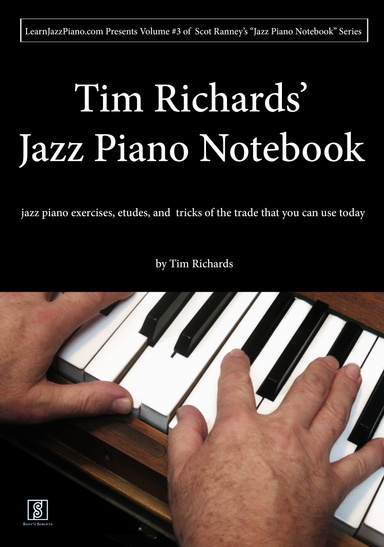
Volume 3 contains 12 jazz piano exercises and explorations by the acclaimed jazz piano educator, pianist, author, and recording artist Tim Richards.
Tim wrote the well known "Exploring Jazz Piano" and "Improvising Blues Piano" books and has several others to his name.
Tim has a new book out Beginning Jazz Piano (Pts 1 and 2)
Many of Tim's books now come with free access to interactive sheet music ONLINE, which permits slowing down of the backing and performance tracks, as well as the option to loop passages for practice purposes.
Tim now also has online VIDEO courses for his books, including Beginning Jazz Piano, Improvising Blues Piano and Exploring Jazz Piano Vol 1:
buy pdf version Tim Richards' Jazz Piano Notebook Volume 3 -
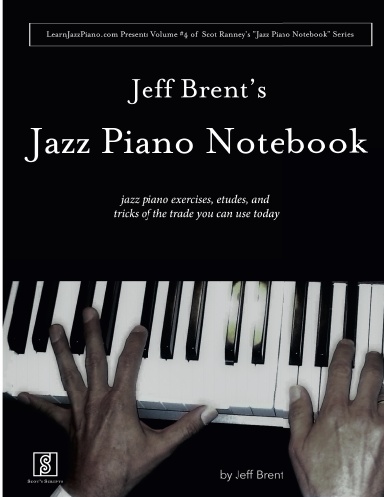
Volume 4 is by Jeff Brent, a jazz pianist, composer, teacher, and author of "Modalogy" and other acclaimed jazz theory and education books. In this book Jeff shares detailed analysis of transcriptions of live performances. He covers everything from the shape of the songs to the tricks and licks he uses in improvised lines to the ideas behind his lush chord voicings.
Most Recent Discussions
Articles
Piano for Adoption Scam
Aprender Jazz en Piano
BEWARE: FREE BABY GRAND PIANO SCAM
Oh Tannenbaum for Jazz Piano
Volume 5 of the "Jazz Piano Notebook Series" is Available!
LearnJazzPiano.com File Downloads News
more...
Top Sheetmusic Picks
Jazzy Christmas Arrangements
Cocktail Piano
Best Songs Ever, 6th Edition
Christmas Medley
Moana Songbook
Late Night Jazz Piano
Jazz piano education is cool.

Rock on. Follow your passion.
Sign In
LearnJazzPiano.com Copyright © 1995-2026 by Scot Ranney • website software and design by scot's scripts
LearnJazzPiano.com is For Sale - Serious Inquiries Only