Arranging Tunes
i'm going to stick to solo piano here since that's where the issues lie. how does one come up with good arrangments for solo piano?
we can lay out the lh techniques, walking tenths, modern stride, arpeggiated chords, etc. but often the music in the midi files here are personal and unique arrangements.
so how does one go about arranging a nice ballad for example?
issues:
1. bass beat often varies (how long can you go without a bass note).
2. rules for mixing up styles (swing and/or slow ballad in same tune).
3. rubato vs. consistent time
4. decisions on time feel.
5. where to put the melody (register and hands).
6. bass only or chords?
7. block chords vs shell voicings
8. ornamentation common in ballads
9. intros and endings
10. octave/unison playing
11. when to walk the bass or when to go for half note bass
12. tenths vs. ninths vs. fifths on bass
i can go on and on here. is there some good book that is a good instructional on this? how did you pros figure this out? or did you just copy somebody else's arrangement?
There are 15 comments, leave a comment.
i'm particularly interested in the thought process of the players who posted midi files here because obviously some advanced thought was made on arranging the tunes. i'm just interested in how they made decisions, particularly since i don't have the long experience to draw from.
i did order solo piano by neal olmsted. i'll get it next week. maybe someone can give us a book review.
intro
verse 1
verse 2
chorus/bridge
solos over verse(s) and/or bridge/chorus
verse 3 (or one of the verses already sung)
chorus/bridge
chorus/bridge
coda
assuming that a section takes up about 20 seconds each, the above arrangement fills up about three minutes.
as for the intro, a common techinque is to use the last 4 bars (or last eight bars) of one of the sections.
as for the coda (aka outro) a common technique is to use what i call a "trio tag" ie. the last line is repeated 3 times then out.
if the vocalist is singing the verses and chorus/bridge then the comping should be minimalistic.
if there is no vocalist, then work out several possible solo scenarios to fill up the time between stating the head(s) at the beginning and end of the piece.
as for lh work during the solo sections, it's great to be innovative but often a solid yet simple lh is the best approach.
as far as clever tricks to include, go listen to the "best midis on ljp", decide what you like and then slow 'em down with vanbasco and steal like mad - you can't go wrong.
just don't forget to try to figure out the thought process behind those tunes so you can build upon those principles to enhance your own improvisations/compositions.

i do it the simple way right now. i stick to only a couple of styles. i do the modified stride (1 + 5, or 1 + chord) on the lh with melody on the rh. or i do a tenth on the left hand and melody on the rh. if i want to lay a groove, i walk the bass or do the half-note bass as i learned here. it is very simple. it doesn't compare with what you guys do and that makes me think it is insufficient at least for solo piano. it doesn't seem flowery enough.
thanks for the intro/outro tips.
7's advice is pertinent to our struggling group as we are currently trying to work out what we should be doing in terms of song orders and how long it would take if we were performing etc. i'm assuming that the comping should support but at least 'not get in the way' of soloists as well as vocalists?
if you are looking at more "flowery" then maybe get some books such as the steinway and sons "piano stylings" books. there are three of them, and they are more of a cocktail style than jazz, but they will certainly teach you some interesting things about arranging and they are ideally suited for solo piano.
i learned an enormous amount from these books, mainly in terms of playing more interesting chords. i knew how to make interesting chords, but found i wasn't really applying them very well until i analyzed what was going on in these arrangements.
i did say i am familiar with the above styles you mentioned and i use them as well. but i noticed a lot of mixing of these styles. doug's passing chords -- i'll look at that. in the past doug's stuff has been understandable because the styling is consistent and the groove is fixed. scot's stuff, from memory, tends to be quite varied. he comes to mind as doing other stuff in addition. maybe i'm seeing passing chords in both lh and rh and when you're watching the van basco midi player, it looks more complex than it really is. maybe a lot of it is just arpeggiated passing chords?
touche on the key! lol. i was just going off from memory of what i heard. with cm7 against the g it sure reminded me of the v chord, without thinking about the key. however, as a general technique though, i've seen that the drone used is often the v chord. i remember a specific application of it with someone playing "linus and lucy" (not guaraldi). this drone is something i hear frequently in solo piano. a pretty good effect.
this is one of the issues of arranging i'm talking about. i see what he is doing on the left hand. he uses partial stride, then he would go into the chord, and would go half step up and down, i guess that would be the passing chord you're referring to. that would be a good one to practice. technically ok. that's a good one to learn.
i also see him using the drone on the lh.
the rh is not as clear to me. now not knowing anything better, let's say i encountered the tune for the first time, i would play melody on the rh and the lh pattern as described above. but if you listen to this, he is not playing just a melody with the rh. it is a complex rework of the melody.
how does one analyze a new tune and come up with all this? there's a lot of ornamentation. is he just improvising in between gaps in the melody? it is not a question of complexity. by itself it is not complex to execute. what is complex is how to come up with the idea itself. remember here that the lh is already playing a chord. so repeating the chord on the rh would be doubling. and he is not doing that.
now i'm listening to scot on speak low. i see the left hand either walking or doing half note bass patterns. sometimes doing stride. but the rh is definitely not doing just melody. he is doing chords with melody. i can't tell if the lh hand is helping with some of the chords there.
the question is how does one learn to do this kind of arranging. obviously one cannot just pick up a lead sheet and start doing all this. it is apparent that a lot of thought was made in organizing these tunes. so this is kind of an advanced lesson question. arranging tips.
scot always mentions the ten finger concept vs. two hands but it's hard to interpret that and apply in a practical sense without some actual exercises to think about.
comments?
"melody played by both hands 2 octaves apart. chords played in gaps between melodic phrases. etc..."
that was helpful, because it explained specifically what's going on.
if you have cakewalk, the comments appear above each section in question (in vanbasco they just appear in the "lyrics window" which is not particularly useful).
maybe doug will respond to your post and give you more info on how to access these incredibly useful and educational comments.
as far as scot's playing is concerned, he's an enigma <g>
in any case 7, obviously solo piano is a different animal and the explanations about doing this are sparse. each one of these must have taken a lot of work either from just long experience or arranging skill. i can pick up little things by myself but there's a lot here.
any other tips you can add in general about arranging solo piano?
Are you in the Pacific Northwest looking for a jazz jam? Check out our weekly Bellingham Jazz Jam!
Jazz Piano Notebook Series

Volume 1 of this educational jazz piano book contains 15 jazz piano exercises, tricks, and other interesting jazz piano techniques, voicings, grooves, and ideas Scot Ranney has picked up over decades of playing on stage.
Being a pro jazz pianist requires good ears, experience, and a bag of tricks that create the kinds of sounds people expect to hear from a jazz pianist. The entries in this book will give you some of those tricks.

"Latinesque"
Volume 2 has 14 jazz piano exercises and tricks of the trade, and quite a bit of it is Calypso jazz piano related material, including some Monty Alexander and Michel Camilo style grooves. Jazz piano education is through the ears, and books like this help connect what you're hearing to what you want to play.
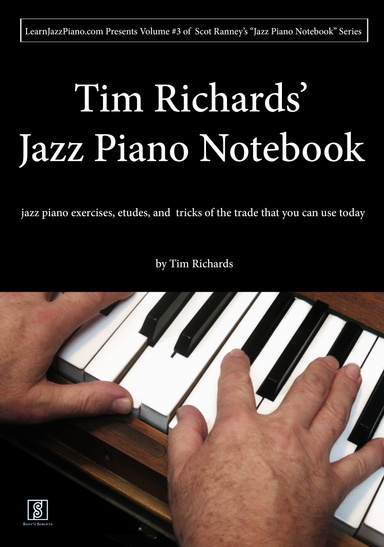
Volume 3 contains 12 jazz piano exercises and explorations by the acclaimed jazz piano educator, pianist, author, and recording artist Tim Richards.
Tim wrote the well known "Exploring Jazz Piano" and "Improvising Blues Piano" books and has several others to his name.
Tim has a new book out Beginning Jazz Piano (Pts 1 and 2)
Many of Tim's books now come with free access to interactive sheet music ONLINE, which permits slowing down of the backing and performance tracks, as well as the option to loop passages for practice purposes.
Tim now also has online VIDEO courses for his books, including Beginning Jazz Piano, Improvising Blues Piano and Exploring Jazz Piano Vol 1:
buy pdf version Tim Richards' Jazz Piano Notebook Volume 3 -
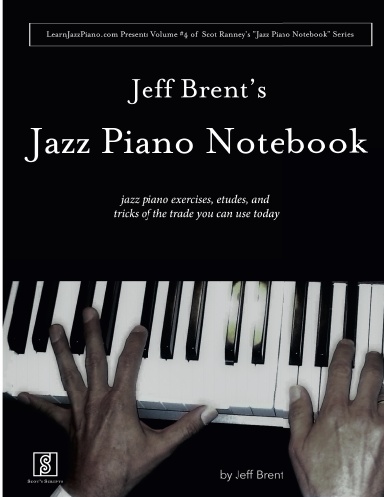
Volume 4 is by Jeff Brent, a jazz pianist, composer, teacher, and author of "Modalogy" and other acclaimed jazz theory and education books. In this book Jeff shares detailed analysis of transcriptions of live performances. He covers everything from the shape of the songs to the tricks and licks he uses in improvised lines to the ideas behind his lush chord voicings.
Most Recent Discussions
Articles
Piano for Adoption Scam
Aprender Jazz en Piano
BEWARE: FREE BABY GRAND PIANO SCAM
Oh Tannenbaum for Jazz Piano
Volume 5 of the "Jazz Piano Notebook Series" is Available!
LearnJazzPiano.com File Downloads News
more...
Top Sheetmusic Picks
Jazzy Christmas Arrangements
Cocktail Piano
Best Songs Ever, 6th Edition
Christmas Medley
Moana Songbook
Late Night Jazz Piano
Jazz piano education is cool.

Rock on. Follow your passion.
Sign In
LearnJazzPiano.com Copyright © 1995-2026 by Scot Ranney • website software and design by scot's scripts
LearnJazzPiano.com is For Sale - Serious Inquiries Only