playing jazz in 6/8 learning to play triplet solos?
are there any jazz tunes for 6/8? i discovered that it was very hard to play tunes in 6/8 because the language seems to be kinda different. is this a good way to learn to play solo lines that are triplet based? i think it might be...
There are no comments, leave a comment.
i'm not entirely sure why you think that it would be easier to play triplets in 6/8 than any other time signature though? perhaps you could describe in more detail what you are trying to do and what problems you are experiencing and i'm sure we'll do our best to give you some help.
there is a huge difference between 3/4 & 6/8. in 3/4 there is no sceondary accent and if we count at the eighth note level we have triple duplets. the time signature 6/8 is composed of duple triplets.
willie nelson's "crazy" (which is pretty much jazz changes) is in 6/8. (speaking of that, have you ever heard diana krall's version? what a piece of crap! she definitely should've married me instead of elvis costello.)
all irish jigs are in 6/8.

tia - scott
seriously, for that fats domino thing -- check "the fat man" or "so long." real core stuff for triplet feel with a bit of flash. anytime you start feeling like you've got it all together, bring it back home to some of that new orleans style, or the kind of r&b sonny clark plays on those don wilkerson sides -- keeps you from getting too fey and ethereal.
in 6/4 time, quarter notes get the beat when you count time.
that's why we say something in 12/8 is "in 4". something in 6/8 is "in 2," and something in 3/4 is "in three." a jazz waltz is not 6/8. it's always 3/4. and a tune in 6/8 could easily be written "2/4" or "4/4," just with triplets. a good example is bobby timmons "dat dere," which could be written in 6/8 or 12/8, or in 4/4 (but with triplets). the song sounds like it's in four.
so yeah, basically 6/8 is like a measure of 2/4, but using triplets on every beat.
every song in 3/4 can be approached like it's in 6/8, however, like 7 said. in songs in 3/4, you may comp on the dotted quarter note. in fact, this is what happens often on the miles recording of someday my prince will come. bill evans especially was a champion of this device.
sdm; this is kind of what you're talking about, i think. this is called a metric modulation, and it happens a lot in bill evans' playing, and also in herbie hancock's.
basically, if you're in a tune in 3/4, and you're comping that dotted quarter rhythm so you're hitting two times a measure, you could make that dotted quarter note hit the quarter note of a new tempo, and swing (or double time!) that quarter note. i know this is really confusing, but i think that's what you were getting at, and by all means you can do it. it's called metric modulation. listen carefully to bill evans' trio albums or the miles davis complete my funny valentine/four and more concert and you'll hear this everywhere.
zl
are there any jazz tunes for 6/8? i discovered that it was very hard to play tunes in 6/8 because the language seems to be kinda different. is this a good way to learn to play solo lines that are triplet based? i think it might be...
Are you in the Pacific Northwest looking for a jazz jam? Check out our weekly Bellingham Jazz Jam!
Jazz Piano Notebook Series

Volume 1 of this educational jazz piano book contains 15 jazz piano exercises, tricks, and other interesting jazz piano techniques, voicings, grooves, and ideas Scot Ranney has picked up over decades of playing on stage.
Being a pro jazz pianist requires good ears, experience, and a bag of tricks that create the kinds of sounds people expect to hear from a jazz pianist. The entries in this book will give you some of those tricks.

"Latinesque"
Volume 2 has 14 jazz piano exercises and tricks of the trade, and quite a bit of it is Calypso jazz piano related material, including some Monty Alexander and Michel Camilo style grooves. Jazz piano education is through the ears, and books like this help connect what you're hearing to what you want to play.
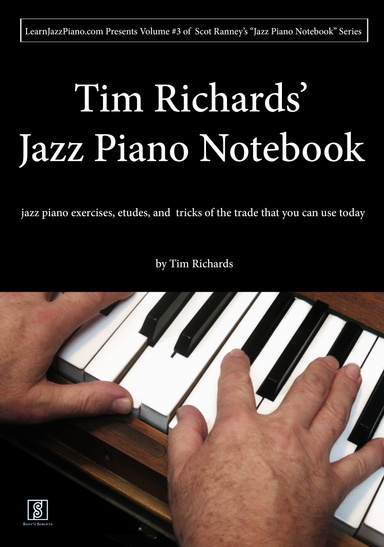
Volume 3 contains 12 jazz piano exercises and explorations by the acclaimed jazz piano educator, pianist, author, and recording artist Tim Richards.
Tim wrote the well known "Exploring Jazz Piano" and "Improvising Blues Piano" books and has several others to his name.
Tim has a new book out Beginning Jazz Piano (Pts 1 and 2)
Many of Tim's books now come with free access to interactive sheet music ONLINE, which permits slowing down of the backing and performance tracks, as well as the option to loop passages for practice purposes.
Tim now also has online VIDEO courses for his books, including Beginning Jazz Piano, Improvising Blues Piano and Exploring Jazz Piano Vol 1:
buy pdf version Tim Richards' Jazz Piano Notebook Volume 3 -
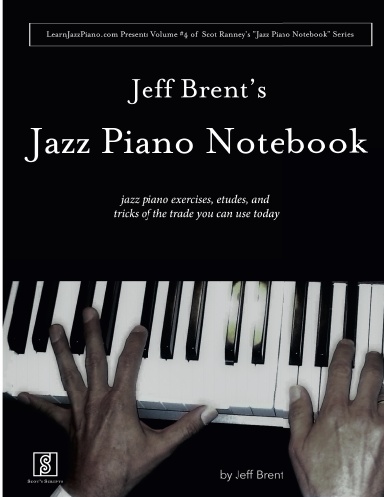
Volume 4 is by Jeff Brent, a jazz pianist, composer, teacher, and author of "Modalogy" and other acclaimed jazz theory and education books. In this book Jeff shares detailed analysis of transcriptions of live performances. He covers everything from the shape of the songs to the tricks and licks he uses in improvised lines to the ideas behind his lush chord voicings.
Most Recent Discussions
Articles
Piano for Adoption Scam
Aprender Jazz en Piano
BEWARE: FREE BABY GRAND PIANO SCAM
Oh Tannenbaum for Jazz Piano
Volume 5 of the "Jazz Piano Notebook Series" is Available!
LearnJazzPiano.com File Downloads News
more...
Top Sheetmusic Picks
Jazzy Christmas Arrangements
Cocktail Piano
Best Songs Ever, 6th Edition
Christmas Medley
Moana Songbook
Late Night Jazz Piano
Jazz piano education is cool.

Rock on. Follow your passion.
Sign In
LearnJazzPiano.com Copyright © 1995-2026 by Scot Ranney • website software and design by scot's scripts
LearnJazzPiano.com is For Sale - Serious Inquiries Only